

Introduction
Misidentifying door handing can lead to costly installation errors and functional problems that disrupt project timelines. This guide will help you:
- Determine door handing
- Measure openings accurately
- Troubleshoot common selection problems
So you can tackle these challenges with confidence. In tornado-prone regions like Nebraska, such oversights can have serious implications for safety and code compliance.
Understand Door Handing: Left vs. Right
Misidentifying door handing can complicate installation and affect functionality, making it crucial to understand the definitions clearly:
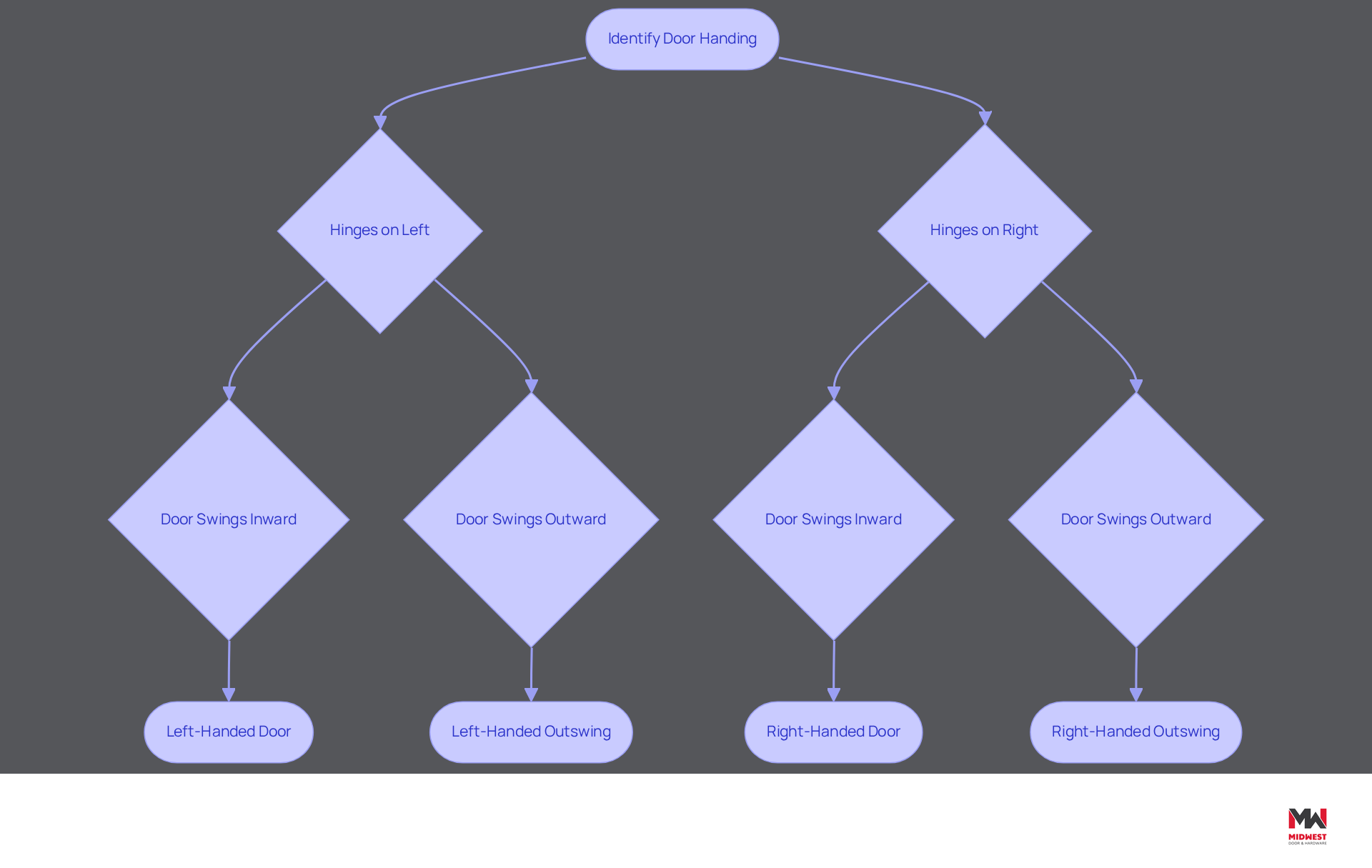
- Left-Handed Door: When standing outside the door, if the hinges are on the left and the door swings inward, it is classified as a left-handed door.
- Right-Handed Entry: Conversely, if the pivots are on the right and the entry swings inward, it is a right-handed entry.
Steps to Identify Door Handing:
- Stand outside the entrance, facing it.
- Observe the position of the hinges:
- If the hinges are on your left, it’s a left-handed door.
- If the hinges are on your right, it indicates a right-handed door in the context of left or right handed door entries.
- Note the direction the door swings:
- If it swings towards you, it’s an inswing door.
- If it swings away from you, it’s an outswing entry.
Understanding these definitions is key to selecting the right door for your project, as it directly impacts installation and functionality. Choosing the correct door handing not only simplifies installation but also enhances the overall functionality of your project.
Measure Your Door Opening Accurately
Accurate measurements are crucial for ensuring a proper fit for your door, as even minor discrepancies can lead to significant installation challenges.
Tools Needed:
- Tape measure
- Level
- Pencil and paper for recording measurements
Steps to Measure:
-
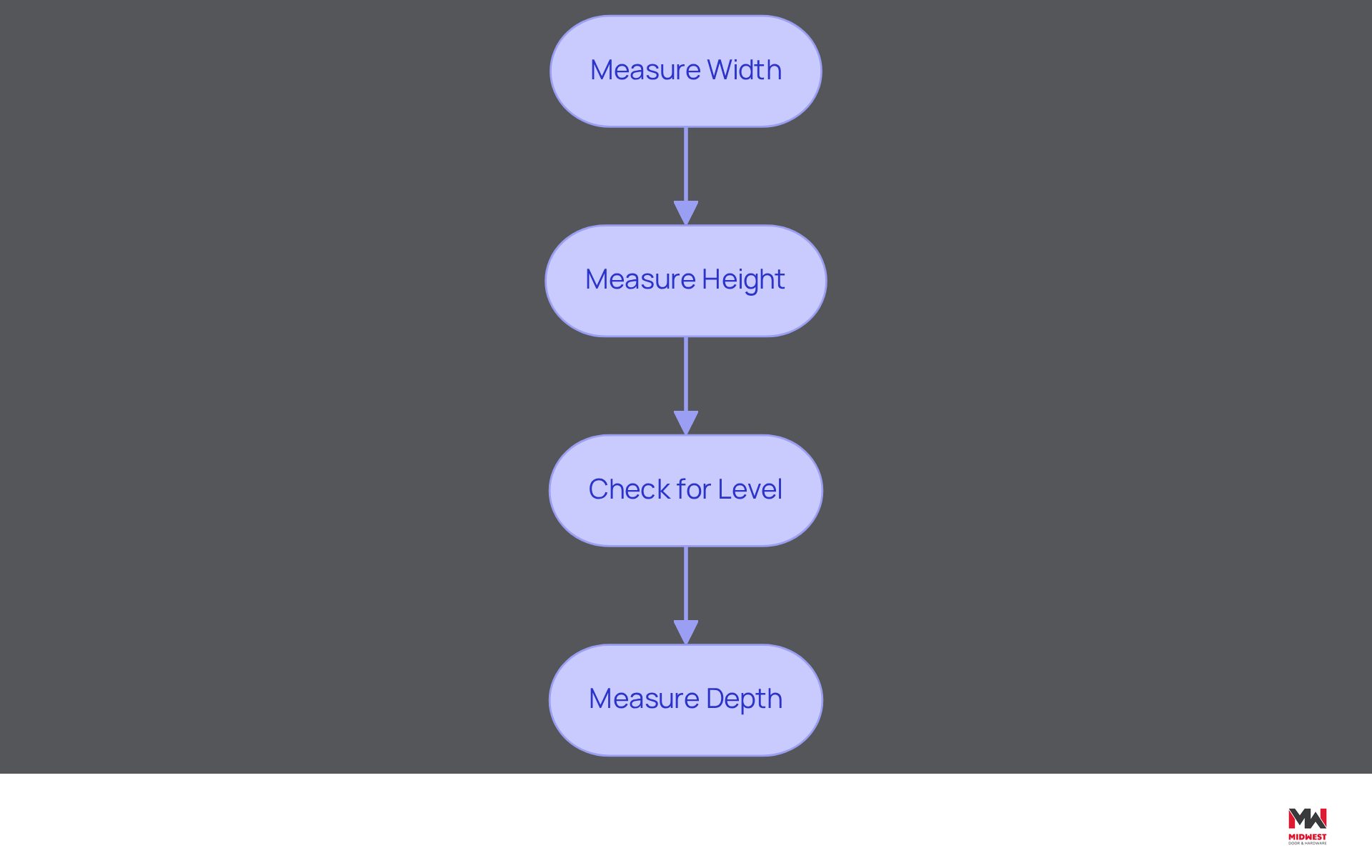
- Measure across the top, middle, and bottom of the door frame.
- Note the broadest dimension to guarantee the entry will fit, as utilizing the narrowest dimension can result in installation problems.
-
- Measure from the top of the frame to the floor on both the left and right sides.
- Again, document the tallest reading to account for any variations in the opening.
-
- Use a level to ensure that the frame is straight. If it’s not, adjustments may be needed to avoid complications during installation.
-
- Measure the thickness of the door frame to ensure compatibility with the door you plan to install.
Getting the numbers right is crucial; nearly half of the rework in U.S. construction comes from poor data and miscommunication. As Kimber Brinkley emphasizes, "Getting numbers wrong wastes money. Precise measurement of the entryway keeps your project on schedule and prevents rework." Following these steps will help you achieve a proper fit for your new entry, minimizing the risk of installation issues.
Compliance with building codes is critical for ensuring safety and functionality. This includes adherence to NFPA 80 for fire-rated entrances, which mandates annual inspection and testing of fire-rated assembly units, and ICC 500 for tornado-rated entrances, which requires that tornado-rated shelter hardware must be listed and compliant with interior egress requirements; non-listed hardware is unacceptable. Understanding the difference between rough openings and finished openings is also vital for accurate measurements, as this distinction can significantly impact the installation process. Neglecting precise measurements and code compliance can jeopardize both the safety and success of your project.
Identify the Door Swing Direction
Identifying the correct door swing is crucial for ensuring compliance with safety regulations and operational efficiency.
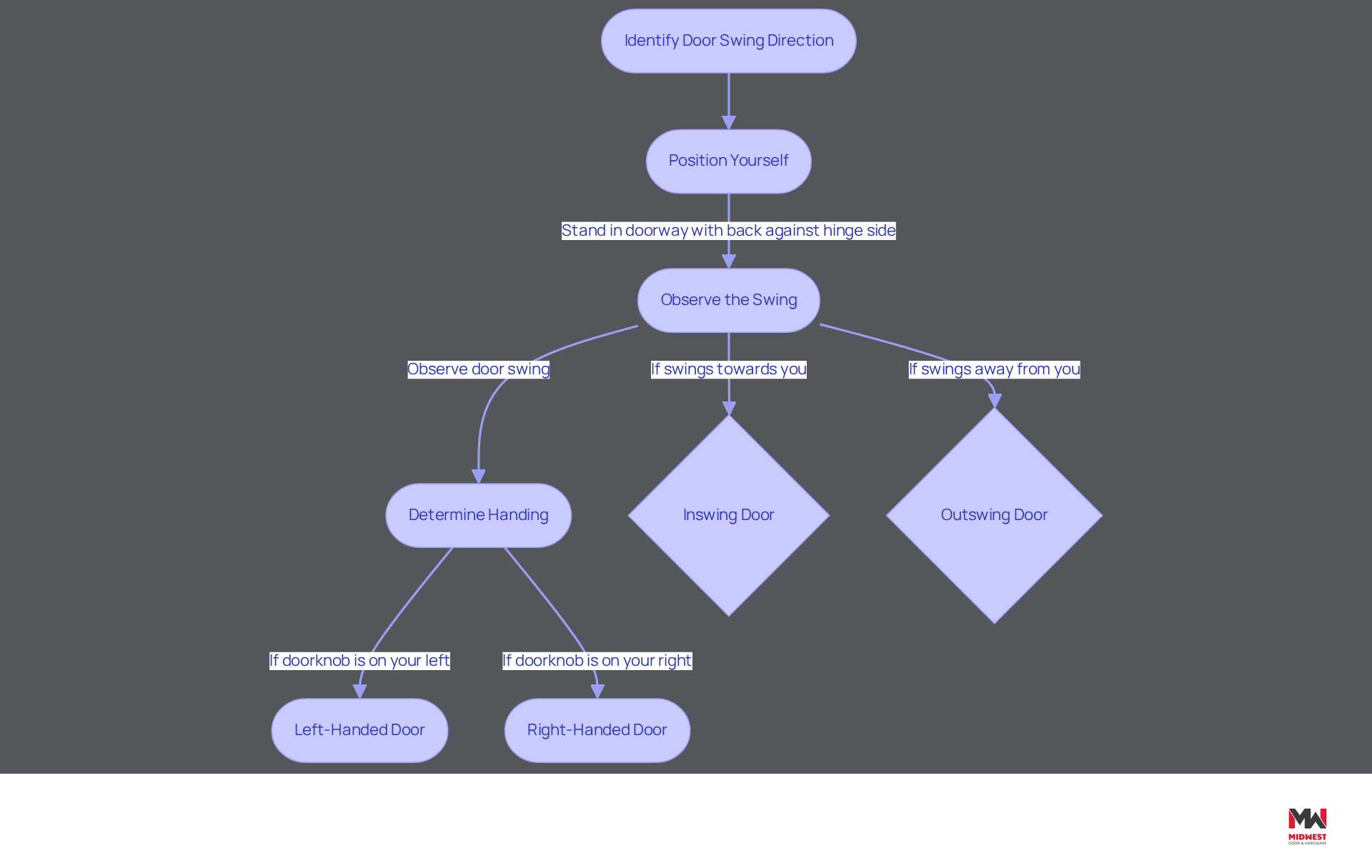
- Position Yourself:
- Stand in the doorway with your back against the hinge side of the door.
- Observe the Swing:
- If the door swings towards you, it is an inswing door.
- If it swings away from you, it is an outswing entry.
- Determine Handing:
- If the doorknob is on your left, it’s a left-handed door.
- If the doorknob is on your right, it’s a right-handed entry.
Example Scenario:
- Imagine standing in front of a door that swings towards you with the hinges on the left; this indicates a left-handed inswing door. On the other hand, if it moves away from you and the hinges are on the right, it is a left or right handed door.
Understanding how the door moves is key to ensuring it functions correctly and meets design specifications. Recent updates to building regulations, such as the International Building Code (IBC), require that entrances in rooms with fifty or more occupants must open outward to facilitate safe egress during emergencies. Compliance with these regulations is vital to prevent crowding and ensure quick evacuation, highlighting the importance of accurately identifying door swings in commercial settings. Additionally, adherence to NFPA 80 necessitates yearly inspection and testing of fire-rated entry assemblies, ensuring safety and functionality. This includes understanding hinge types and their uses, along with the specifications for commercial wooden entries, which are crucial for contractors to grasp. Furthermore, compliance with ICC 500 standards for tornado-rated entries is essential for safety in storm shelters, particularly in Nebraska's tornado-prone climate, with no substitutions allowed. For contractors, utilizing products from Midwest Door & Hardware, including brands like Sargent and Dormakaba, along with the unique in-house fabrication shop, can provide customized solutions tailored to specific project needs. Understanding these specifications not only enhances safety but also protects contractors from potential liabilities.
Troubleshoot Common Issues in Door Selection
Selecting the right door can present several challenges that, if not addressed, may lead to significant project setbacks. Here’s how to troubleshoot common issues:
-
Incorrect Measurements:
- Issue: The door does not fit the opening.
- Solution: Double-check your dimensions, ensuring you account for any irregularities in the frame. Measurement errors can lead to costly delays and rework, impacting project timelines and budgets.
-
Confusion Over Handing:
- Issue: Uncertainty about whether the door is left or right-handed.
- Solution: Revisit the steps outlined in the 'Understand Door Handing' section to clarify. Proper identification of a left or right handed door's entry handing is essential for functionality and aesthetics.
-
Swing Direction Conflicts:
- Issue: The door swings into a wall or another obstruction.
- Solution: Consider a different entry type or adjust the swing direction by selecting an outswing option if space allows. This adjustment can prevent operational issues and enhance usability.
-
Hardware Compatibility:
- Issue: The selected hardware does not fit the door.
- Solution: Confirm that the hardware specifications align with the entry type and handing to avoid installation delays and ensure safety.
By proactively addressing these common issues, you can ensure a smoother installation process and enhance the longevity of your door systems. Remember, adherence to standards such as ICC 500 for tornado-rated entries and NFPA 80 for fire-rated entries, including the requirement for annual inspection and testing of fire-rated assembly units, is essential for compliance and safety. As noted by industry expert Ivan Petrushin, "Proper installation and maintenance are crucial for door longevity and performance.

Conclusion
Accurate identification of door handing is crucial for successful installation and optimal functionality. This guide clearly defines left-handed and right-handed doors and provides a step-by-step method for identification. Accurate identification simplifies installation and enhances door performance within its intended space.
Key insights discussed include:
- The importance of precise measurements
- Compliance with building codes
- The identification of door swing directions
Each of these elements plays a critical role in avoiding common pitfalls that can lead to costly delays and safety issues. Additionally, troubleshooting common selection problems ensures that contractors can navigate challenges effectively, reinforcing the significance of proper door selection and installation.
Contractors and project managers will find this knowledge essential for their projects. By leveraging resources from Midwest Door & Hardware, including their comprehensive product brands and unique in-house fabrication shop, professionals can ensure that their door selections meet both functional and aesthetic requirements. Emphasizing the importance of adherence to safety standards, such as those set by NFPA 80 and ICC 500, highlights the necessity of thorough preparation and execution in every project. These practices not only ensure compliance and safety but also significantly enhance the success of construction projects.
Frequently Asked Questions
What is door handing?
Door handing refers to the classification of doors based on the position of the hinges and the direction in which the door swings.
How do I identify a left-handed door?
A left-handed door is identified when standing outside the door, with the hinges on the left side and the door swinging inward towards you.
How do I identify a right-handed door?
A right-handed door is identified when standing outside the door, with the hinges on the right side and the door swinging inward towards you.
What is the difference between inswing and outswing doors?
An inswing door swings towards you when opened, while an outswing door swings away from you.
Why is it important to understand door handing?
Understanding door handing is crucial for proper installation and functionality, as misidentifying it can complicate the installation process and affect how the door operates.
List of Sources
- Understand Door Handing: Left vs. Right
- Client Challenge (https://special-lite.com/how-to-determine-door-handing-a-comprehensive-guide)
- Right-Hand vs. Left-Hand Doors: How To Choose (https://nicksbuilding.com/blog/right-hand-vs-left-hand-doors-how-to-choose?srsltid=AfmBOopxxOlgFtHXs64-LRSulUFERo7NGpyRtuXlFRDdRyV5kWJZ_ssU)
- Determining Door Handing (https://directdoorhardware.com/door-handing.htm?srsltid=AfmBOoqkAdHfFiE0frd5ZQZzhjLY5hXs9asj2SsJlz2uNMntp3TnmB9z)
- » Dash Demystifies Door Handing – It Doesn’t Have to Be Complicated (https://dashdoor.com/resource-center/technical-articles/dash-demystifies-door-handing-it-doesnt-have-to-be-complicated)
- Master the Door Handing Chart: Steps for Midsize Contractors (https://midwestdoor.net/news/master-the-door-handing-chart-steps-for-midsize-contractors)
- Measure Your Door Opening Accurately
- How to Measure for a New Commercial Door (https://cdfdistributors.com/blog/post/how-to-measure-for-a-new-commercial-door)
- How Do You Measure Window and Door Openings for New Construction? Complete Guide (https://airmasterwindows.com/how-to-measure-a-window-or-door-opening-for-new-construction)
- The Complete Professional Guide to Door Measurement for Self-Storage and Commercial Applications (https://steelbluebc.com/news-posts/the-complete-professional-guide-to-door-measurement-for-self-storage-and-commercial-applications)
- Door Measurement Guide: Tips & Tricks (https://gladiatorwindowanddoors.com/blogs/news/door-measurement-guide-tips-tricks?srsltid=AfmBOoqRa9mhkDB6A-o5scBNyiydgCxTt8aJbzCs9hrqfrTh17LOusl8)
- How to measure a front door | Andersen Windows (https://andersenwindows.com/ideas-and-inspiration/blog/tips/how-to-measure-door)
- Identify the Door Swing Direction
- Should Commercial Doors Swing In or Out? Everything You Need to Know (https://pdqlocks.com/blog/should-commercial-doors-swing-in-or-out)
- 3 Ways To Determine Door Swing Direction & Choose the One That’s Right for You (https://panda-windows.com/blog/3-ways-to-determine-door-swing-direction-and-choose-the-one-that-s-right-for-you)
- Decoded: Door Swing (https://idighardware.com/2026/03/decoded-door-swing)
- Spark Notes: Door Swing Direction (https://sgh.com/insight/spark-notes-door-swing-direction)
- Door Swing Chart (Door Handing Guide) - CDI Doors (https://cdidoors.com/door-swing-chart-door-handing-guide)
- Troubleshoot Common Issues in Door Selection
- Top 5 Door Problems & Solutions for Them (https://doorslosangeles.com/blog/common-door-problems-solutions?srsltid=AfmBOooIJKSy7Tb1EbdFGOaREW1lXll31hjSLlODaLRnnYLoyADzfDww)
- What Mistakes Homeowners Must Avoid During Garage Door Installation in Beavercreek (https://daytondoorsales.com/blog/what-mistakes-homeowners-must-avoid-during-garage-door-installation-in-beavercreek)
- Common Door Installation Problems and Fixes | EZ-Hang Door (https://ezhangdoor.com/common-door-installation-problems-and-fixes)
- 5 Common Door Problems & How to Fix Them (https://roofmaxx.com/learning-hub/common-door-problems)
- Common Door Problems and How to Fix Them | Golden Windows (https://goldenwindows.com/blog/common-door-problems-and-how-to-fix-them.html)
Related News
Check out more of what we’ve worked on.