
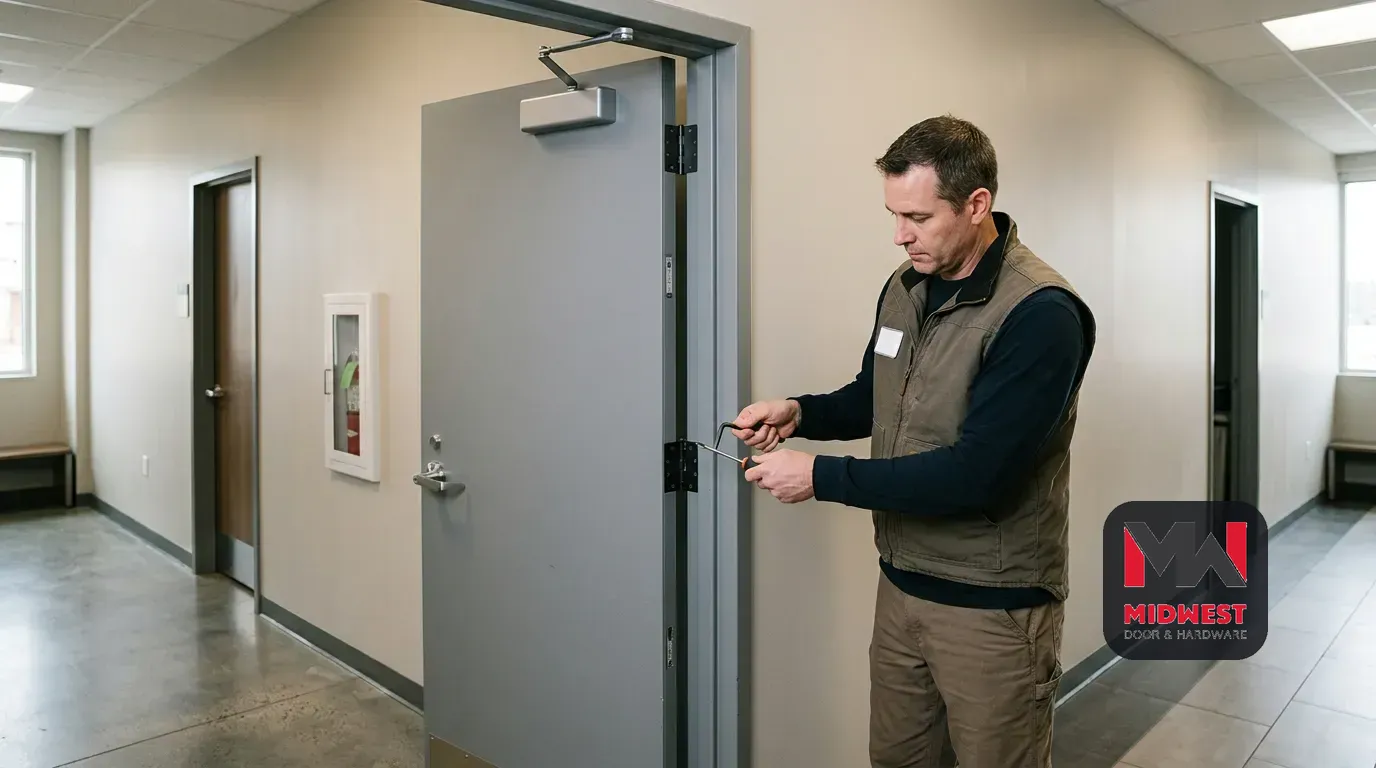
adjust self closing door hinge
How to Adjust a Self-Closing Commercial Door Hinge
Begin with the device, not the symptom
Self-closing commercial door hinge adjustment begins with identifying the device, not with guessing at a tension setting. A traditional spring hinge supplies return force, but it does not control closing speed. If the door still slams after correct tensioning and alignment, the opening may need hydraulic damping or another suitable self-closing device. An overhead commercial door closer uses different functions: sweep speed controls the main closing movement, while latch speed controls the final movement toward the frame.
The opening itself is a coordinated assembly. Hanging, locking, controlling, and protecting functions need to work together and match conditions such as door weight, traffic, wall substrate, and fire-rating requirements. A hinge adjustment can improve one part of that assembly without correcting a problem in another part.
That distinction matters on Nebraska commercial work. A school opening in Lincoln, an office in Omaha, or a community-center project in Scottsbluff may show the same symptom—a door that does not close correctly—while requiring different hardware decisions. Start by identifying whether you are working with a spring-loaded hinge, an overhead closer, or another self-closing device. Then use the instructions for that device and let the opening conditions determine whether adjustment is an appropriate next step.
Record the opening conditions before adjusting
An opening-condition record gives you a practical basis for deciding whether hinge adjustment is appropriate. Record the following before changing the hardware:
- The device type, visible model information, and location of any adjustment points.
- The symptom: failure to close, slamming, failure to latch, or resistance during movement.
- Whether the symptom occurs through the full swing or only near the latch.
- Visible conditions at the door, frame, hinges, fasteners, strike, and other related hardware.
- The intended role of the opening, including whether it is fire-rated or serves required egress.
- The closing and latching result before adjustment so you can compare the result afterward.
Treating the opening as a complete assembly matters because door weight, traffic, substrate, and fire-rating conditions affect hardware coordination. A tension change should not be treated as an isolated fix when the door, frame, lock, strike, closer, and hinge system are interacting.
Nebraska project records can use the same format for a hospital in North Platte, a school in Grand Island, an office in Council Bluffs, or a public-building renovation near Lincoln’s Haymarket District. The location does not establish the correct hinge setting. It does make a clear project record useful when several trades or openings are involved.
A fire-rated label changes the decision path. Preserve the label and identify the opening as fire-rated before adjusting. If multiple hinges show fatigue, or if the opening is fire-rated or serves required egress, stop treating the issue as a routine tension adjustment and involve a qualified door hardware professional.

Let the exact hinge instructions set the method
The exact hinge instructions determine the adjustment method, tools, sequence, and limits. Self-closing hinge sets do not share one universal procedure. Some products use a tension adjustment point and a separate stopper; others may combine spring tension with a speed-control function or use a different tool arrangement. Use the instructions for the installed hinge set rather than transferring a procedure from another product.
Before making a change, identify the adjustment end, the tool specified by the instructions, and the condition in which the adjustment is allowed. Keep the product instructions with the opening record. If the model cannot be identified or the instructions are unavailable, do not assume that a familiar-looking hole, pin, screw, or hex point has the same function as one on another hinge.
The distinction between model-specific guidance and general guidance is essential. A general process can tell you to identify, adjust, test, and document. It cannot tell you how many positions, turns, or holes every hinge will accept. Treat every stated limit as belonging to the exact hinge model and its instructions.
Use a controlled adjustment-and-test cycle
A controlled adjustment-and-test cycle keeps a small hardware change from becoming an uncontrolled setting change. Use this general sequence, then apply the exact product instructions at each step:
- Confirm the hinge type and read the adjustment instructions before touching the adjustment point.
- Put the door and hinge in the condition required by those instructions. For the specified spring-loaded hinge procedure, torque adjustment is performed only after the hinge is installed and the door is closed.
- Make one limited adjustment with the specified tool and in the specified direction. Do not assume that the direction or amount of movement is shared by another hinge design.
- Remove or release the adjustment tool as directed, then operate the door through its closing cycle.
- Check whether the door closes with the expected force and whether it reaches the intended latch position. Record what changed.
- Repeat only when the product instructions permit another adjustment, and stop when the result does not improve or another condition becomes apparent.
For the specified spring-loaded hinge procedure, the instructions direct you to test the closing cycle and force after the adjustment. If the door does not close, the documented procedure may be repeated, followed by a final step that secures the tension stopper pin flush with the hinge barrel. That sequence applies to the specified hinge procedure, not to every self-closing hinge.
A test result should describe behavior rather than simply say “adjusted.” Record whether the door closed from the tested position, whether it latched, whether it slammed, and whether the symptom changed. A change in one part of the cycle can reveal that the remaining issue belongs to the closer, strike, alignment, frame, or another component of the opening.

Treat tension limits as model-specific
Adjustment limits belong to the hinge model and its instructions, not to the phrase “self-closing hinge.” One specified spring-loaded hinge instruction sets these limits: no more than three holes of tension for a 180-degree door opening or four holes of tension for a 90-degree opening. Those numbers are an example of a product-specific limit, not a universal setting for commercial doors.
Use the opening position stated in the instructions when interpreting a limit. Do not substitute a different opening angle, count positions on a different hinge, or continue past the stated limit because the door still does not close. If the hinge reaches its permitted adjustment and the door remains problematic, return to the opening record and look for another cause or arrange qualified service.
The correct field question is not “How many holes should every self-closing hinge use?” The correct question is “What does this installed hinge’s documentation permit, and does the tested result satisfy the opening’s requirements?” Keep that answer with the project documentation.
Read each closing symptom as a clue
Closing symptoms are clues, not proof that hinge tension is the cause. Use the symptom to choose the next inspection point rather than turning the adjuster repeatedly.
- The door does not close: Confirm that the hinge is the correct device and that the documented adjustment procedure was followed. If the door still does not close, inspect the opening as a coordinated assembly instead of assuming more tension will solve it.
- The door closes too aggressively or slams: A traditional spring hinge provides return force, not closing-speed control. If correct tensioning and alignment do not resolve the slamming, the opening may need hydraulic damping or another suitable self-closing device.
- The door closes but does not latch: Check the strike selection and closer adjustment while recognizing that the symptom can have other causes. A hinge setting alone does not establish that the lock, strike, frame, and closing device are coordinated.
- The door binds or its movement changes through the swing: Revisit the hanging, locking, controlling, and protecting functions together. The condition may involve alignment, frame interaction, hardware coordination, or another opening factor rather than spring tension alone.
An overhead closer requires a different interpretation from a spring hinge. On the specified type of commercial closer, sweep speed governs movement from fully open to approximately 12 to 15 degrees from the frame, while latch speed governs the final 12 to 15 degrees. Do not use an overhead-closer speed adjustment as though it were a spring-hinge tension adjustment.
This symptom-based approach is useful on a midsize contractor’s project because it separates a limited adjustment from a broader coordination issue. It also prevents a smooth close from being treated as the only measure of a successful commercial opening.
Know what hinge tension cannot correct
Hinge tension cannot correct every condition that prevents reliable door operation. Stop adjusting and consider hinge replacement when the spring is visibly broken, a hinge leaf is bent, fastener holes have worn into oval shapes, or the maximum permitted adjustment produces no improvement.
A spring hinge also cannot create closing-speed control that the device does not provide. If the door continues to slam after correct tensioning and alignment, a suitable hydraulic self-closing device or other damping component may be needed. More spring tension is not a substitute for that function.
Misalignment, frame conditions, worn or fatigued parts, strike problems, and incompatible hardware also sit outside a simple tension change. The opening should be treated as a coordinated assembly whose hanging, locking, controlling, and protecting functions match the door, traffic, substrate, and applicable rating conditions. When the symptom persists after the permitted adjustment, record the condition and move to inspection, replacement, or qualified service rather than forcing the adjustment further.
That boundary is especially useful when several doors show similar behavior. A repeated symptom across a school in David City, an office in Columbus, or a public facility in Aurora may point to a coordination or specification issue that should be reviewed across the opening set, not solved by applying one hinge setting to every door.
Apply the commercial safety gate
Fire-rated and required-egress openings are a commercial safety gate, not a routine smooth-close adjustment. Involve a qualified door hardware professional when an opening is fire-rated, serves required egress, or has multiple fatigued hinges. Those openings have performance requirements beyond making the door move toward the frame.
For a fire-rated opening, verify the applicable NFPA 80 requirements. The door must self-close, and the closing device must be adjusted so the door positively latches on every operation. Spring hinges can be one way to provide self-closing function, but the installed assembly still has to satisfy the applicable requirements.
For a fire-rated assembly, verify the applicable NFPA and IBC requirements for compatible hardware, self-closing and positive self-latching operation, and an intact fire label. Local adoption and project requirements determine which provisions apply, so general hinge guidance does not make the code determination for a specific opening.
Do not remove, obscure, or treat the fire label as incidental while troubleshooting. Do not release an opening based only on the fact that it closes once. If the opening has a fire rating, required-egress function, or another regulated performance requirement, preserve the project review path and use qualified hardware support for the unresolved decision.
Verify latching, labels, and ongoing condition
A closing test is complete only when the result is judged against the opening’s function. For a fire-rated opening, verify self-closing and positive latching on every operation under the applicable NFPA 80 requirements. For the assembly as a whole, verify compatible hardware, an intact fire label, and the required closing and latching behavior under applicable NFPA, IBC, and local requirements.
Use a short result record after the adjustment:
- Identify the opening, hinge or closer type, and instructions used.
- Describe the original symptom and the adjustment made.
- Record whether the door closed, latched, or continued to slam or bind.
- Note any damaged component, worn fastener hole, missing label, field modification, or unresolved condition.
- Mark the opening for qualified review when the result does not meet its intended function.
Fire-door assemblies should be inspected and maintained at least once a year for damaged hardware, missing labels, field modifications, and closing or latching failures, subject to the applicable adopted requirements. An adjustment record should therefore support ongoing maintenance rather than stand alone as proof that the assembly will continue to perform.
The same discipline helps on projects in Nebraska communities, whether the opening serves a hospital in Omaha, a school in Lincoln, a church in Scottsbluff, or an arena in North Platte. The building type changes the opening conditions; it does not eliminate the need to connect the hinge result to the complete assembly.
Document the result and choose the next action
A documented adjustment gives your project team a clear next action: continue with the verified result, stop for qualified review, or arrange repair or replacement. Keep the opening record with the hardware documentation and include the device type, observed symptom, instruction used, permitted adjustment, test result, latching result, and any stop condition.
If the door closes and operates as required for its opening, retain the record for coordination and maintenance. If the door still fails to close, latch, or control its speed, do not keep increasing tension beyond the exact hinge instructions. If the record shows a damaged hinge, fatigued components, an unresolved frame or strike condition, a fire-rated opening, or required egress, move the issue to qualified hardware review.
At Midwest Door & Hardware, we provide commercial door hardware, including hinges, locks, exit devices, door closers, and electrified hardware. We adjust and repair doors, frames, and hardware, and replace worn-out parts. That scope supports questions about a self-closing hinge, but the opening record remains the useful starting point for deciding whether the next action is adjustment, repair, replacement, or broader coordination.
For projects serving contractors and teams in Lincoln, Omaha, North Platte, Scottsbluff, Council Bluffs, Grand Island, David City, Columbus, Aurora, and nearby communities, bring the recorded symptom and test result into the hardware discussion. A qualified professional should decide individual suitability for a specific regulated or complex opening.
When should a self-closing hinge adjustment stop?
Can a self-closing door hinge be adjusted on a commercial opening?
Often, but only after identifying the hinge model and reviewing its instructions. Adjustment may address spring tension, but it will not correct misalignment, damaged components, strike problems, or a missing closing-speed control. Test the door after each permitted change and stop if the result does not improve.
Can I use the same tension setting on every self-closing hinge?
No. Adjustment direction, tools, sequence, and limits vary by hinge design and model. For one specified spring-loaded hinge, the instructions limit tension to three holes for a 180-degree opening or four holes for a 90-degree opening; those limits must not be applied to other products.
When should a door hinge adjustment become a service issue?
Move to qualified hardware review when the spring is broken, a leaf is bent, fastener holes are worn, multiple hinges show fatigue, or the permitted adjustment produces no improvement. Involve qualified support for fire-rated or required-egress openings, where self-closing, positive latching, compatible hardware, and the fire label must remain compliant with applicable requirements.
Start Your Build
Got a project? We'll bring frames, doors, hardware, and the expertise to keep every opening on schedule.