
what is mortise lockset
What Is a Mortise Lockset? A Commercial Door Hardware Guide
What a Commercial Mortise Lockset Is
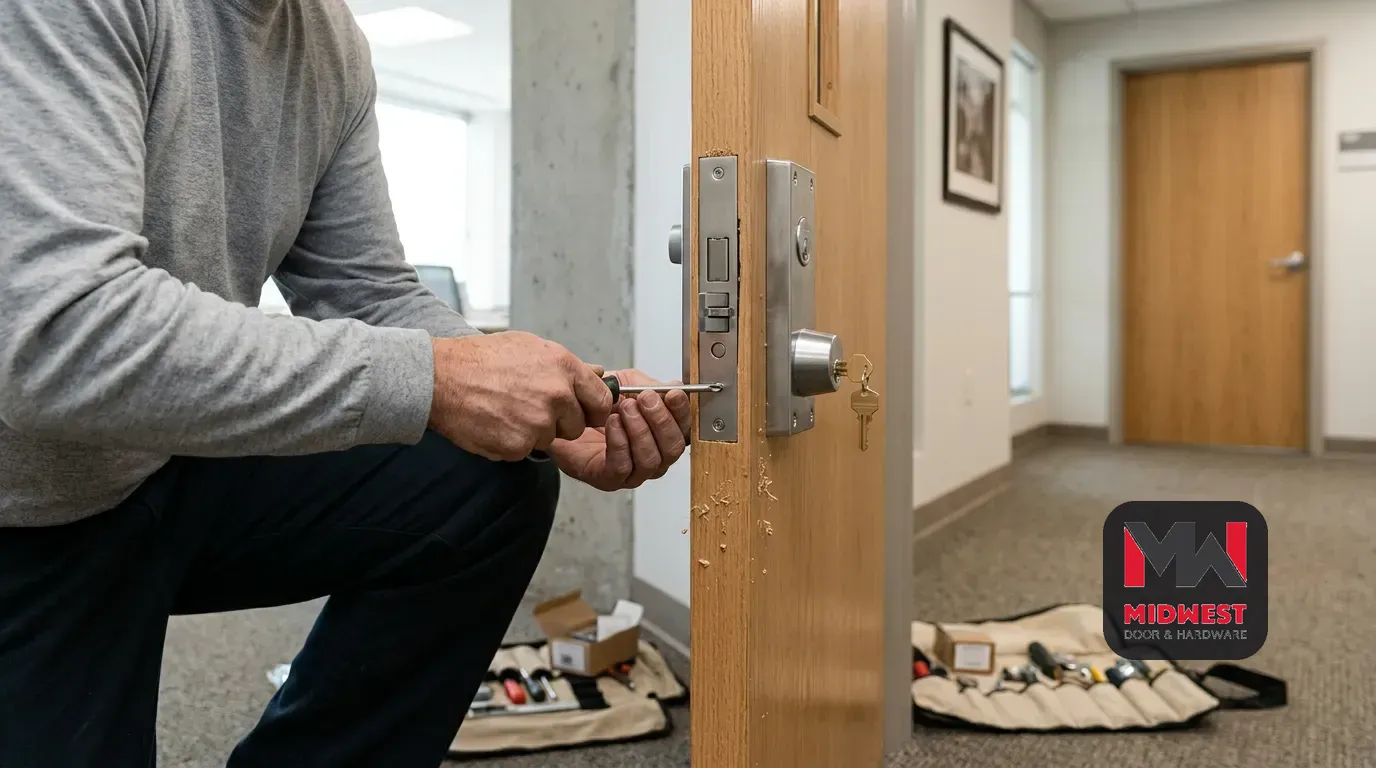
A commercial mortise lockset is an integrated lock assembly recessed into a pocket in the edge of a door. The lock case sits inside the door rather than occupying only the surface or passing through a bored hole. That recessed case is the feature that gives the mortise lock its name and distinguishes it from other commercial lock arrangements.
A commercial mortise lock uses a rectangular case inside a door-edge pocket. A cylindrical lock uses a chassis through bored openings with a separate edge latch. The two types may serve similar broad opening functions, but they require different door preparation and should not be treated as interchangeable choices.
For a secured opening in a Lincoln, Nebraska office, school, hospital, or other commercial facility, the term describes the lock construction—not a complete decision about the opening. The opening still needs a compatible function, trim arrangement, door and frame preparation, access-control interface when applicable, and keying plan. A mortise lockset is therefore best understood as one coordinated hardware component within the door opening.
The distinction also matters during a retrofit. If an existing door already has a mortise pocket, the project begins with a different preparation question than a door prepared for cylindrical hardware. Start with the opening record and existing condition before treating the lock type as a product preference.
How the Lockset Works as Part of the Opening
A mortise lockset works by combining a recessed case with operating trim, a latch or function-specific bolt, an outside interface, and a strike coordinated with the door and frame. The case provides the main lock body inside the edge pocket. The trim provides the user interface, which may be specified as sectional or escutcheon trim or with a round or square rose, depending on the selected product and project requirements.
The operating function determines what the hardware does from each side of the opening. A mortise lock’s deadbolt is available in some functions, but not every mortise lock; a cylindrical lock usually requires a separate deadbolt when one is needed. That difference affects the hardware schedule, the door preparation, and the way the opening is reviewed before ordering.
Mortise locks often offer a broad function range, including institutional and indicator functions. Cylindrical locks also offer a broad commercial range, with fewer integrated bolt functions in the comparison used for this guide. Those descriptions are useful for narrowing the conversation, but they do not identify the right function for a particular classroom, office, storeroom, or secured entry.
The cylinder or electronic interface is another part of the coordination. A mechanical opening may require planning for a cylinder and keying arrangement. An electrified opening may require an electrified mortise lock or related electrical locking accessories. Treat the case, trim, interface, strike, door, frame, and control system as one opening record rather than selecting the lock body in isolation.
Start With Door Material and Preparation
Door and frame preparation should be the first screening question for a new opening or retrofit. Record the door construction, edge condition, existing hardware preparation, frame information, handing, and the hardware schedule before selecting a mortise lock. If the opening is already installed, use the field condition and available project documentation together.
Mortise locks require a series-specific pocket and drilling template. Cylindrical locks commonly use bored preparation, with backset and through-bolt patterns that vary. This means the lock series, preparation template, and existing opening need to agree; a general description such as commercial lock is not enough to establish fit.
For a retrofit, compare the existing preparation with the lock type. Mortise locks fit existing mortise preparation, while cylindrical locks fit existing bored preparation. That comparison does not make either type universally suitable. It identifies the physical starting point for the next review.
Use a short preparation check before discussing finish or trim:
- Is the opening new construction or an existing door?
- Does the door edge have a mortise pocket, or does the door have bored preparation?
- Which lock series and drilling template are named or permitted by the project documents?
- What handing is shown for the opening?
- Does the door and frame information match the hardware schedule?
For a Lincoln or North Platte project, keep this record tied to the individual opening rather than applying one lock choice across every door in the building.

Match the Lock Function to the Opening
The mortise lock function should follow the required operation of the opening. Before selecting trim, finish, or cylinder details, confirm whether the project needs F04, F05, F07, F09, or another function option. The function code is part of the opening decision, not a detail to fill in after the hardware has been chosen.
The door schedule provides the starting context. The procurement guidance specifically identifies office doors, classrooms, storerooms, hotel guest rooms, and apartment entrances as opening types to confirm when selecting a mortise lock function. Commercial project teams can use the same question for other spaces: what is the opening used for, and what operation is required from each side?
Write the required operation in plain language before matching it to a function code. For example, identify which side controls the lock, how the door is intended to operate during ordinary use, and whether the schedule calls for an institutional or indicator function. Do not infer the function from the room name alone when the schedule or project documents specify something different.
A practical function review includes:
- The opening use and room designation.
- The required function code or approved equivalent in the schedule.
- The handing shown for the door.
- The selected trim arrangement and finish requirements.
- Any cylinder, master-key, or access-control requirement that changes the specified operation.
Confirm the function before sourcing the lockset. A correct case with the wrong function still leaves the opening unresolved.
Review Fire-Rated Requirements Before Specification
A fire-rated opening needs a project-specific review before a mortise lock is specified. The lock description alone does not establish that the complete door assembly meets the project requirement. Review the opening documents, the door and frame information, and the hardware schedule together.
Before specifying a mortise lock, confirm whether the product must follow ANSI/BHMA A156.13 Grade 1 requirements. For a fire-door project, also confirm whether the door needs a UL fire-rated mortise lock or a fire-door project evaluation. Those are separate review points and should remain visible in the specification process.
Use the fire-rating screen to organize the documentation you need:
- The rating and labeling information shown for the door and frame.
- The mortise lock requirements stated in the hardware schedule.
- The applicable product listing or fire-door project evaluation.
- The selected function, trim, strike, and other hardware identified for the opening.
- Any project authority responsible for accepting the documented assembly.
Do not substitute a general commercial lock description for the required listing or evaluation. If the opening is part of a school, hospital, office, or community facility, carry the fire-rated review through the same schedule and coordination process used for the rest of the door hardware. The final determination belongs to the applicable project authority and the qualified professionals responsible for the opening.
Coordinate Access Control and Electrification
Access-control coordination determines how an electrified mortise lock participates in the secured opening. A university door-hardware specification requires the contractor to coordinate door-hardware requirements with the University so the hardware achieves the specified operation of the Access Control System. That example shows why the lock should be reviewed with the access-control documents rather than ordered as a stand-alone mechanical item.
The same specification includes electrified mortise locks, electrified emergency-exiting hardware, and electrical locking-system accessories among the devices to be furnished and installed. It also assigns the general contractor responsibility for furnishing and installing the specified door-hardware devices, locks, hinges, other system components, and wiring terminations under that project specification.
For your project, confirm the coordination points in the contract documents:
- Whether the opening requires an electrified mortise lock or a mechanical mortise lock.
- What operation the access-control system must achieve at that opening.
- Which electrical locking accessories are part of the opening.
- Where wiring termination and related installation responsibilities are assigned.
- How the hardware schedule, access-control documents, and door schedule identify the same opening.
Do not assume that an electrified version can be substituted for a mechanical version, or that a mechanical function will provide the required access-control operation. Match the lock, accessories, wiring scope, and specified operation before sourcing the hardware.

Confirm Keying and Cylinder Interfaces
Keying requirements should be confirmed while the mortise lock is being specified, not after the lockset has been ordered. For a mortise-lock project, confirm master-key planning, construction keying, or cylinder override requirements. These questions connect the lockset to the building’s access plan and to the way the opening will be managed during construction and occupancy.
Start with the project keying documents and identify the openings that share a keying plan. Then confirm whether the project calls for a standard cylinder arrangement, construction keying, a master-key structure, or a cylinder override. The exact answer belongs to the project team responsible for the building’s key control and access requirements.
Keep the keying review separate from the mortise-versus-cylindrical decision. A mortise case may be the correct physical lock body while the keying plan still needs its own review. Likewise, choosing a mortise case does not by itself establish which cylinder, key hierarchy, or override arrangement belongs on the opening.
Record the following before requesting the lockset:
- The opening number and room or space designation.
- The required master-key relationship, if one is specified.
- Construction keying requirements during the project.
- Any cylinder override requirement.
- The person or project role responsible for approving the keying plan.
A clear keying record gives the hardware schedule a defined interface instead of leaving access decisions to product selection.
Mortise and Cylindrical Hardware: The Practical Difference
Mortise and cylindrical hardware differ first in how each occupies and uses the door preparation. The practical comparison is about the existing opening, the required function, and the coordination work—not about declaring one lock type universally superior.
| Coordination point | Mortise lock | Cylindrical lock |
|---|---|---|
| Basic construction | Rectangular case inside a door-edge pocket | Chassis through bored openings with a separate edge latch |
| Door preparation | Series-specific pocket and drilling template | Commonly bored preparation, with backset and through-bolt patterns that vary |
| Deadbolt arrangement | Available in some functions, but not every mortise lock | Usually specified as a separate device when a deadbolt is required |
| Function range | Often broad, including institutional and indicator functions | Broad commercial range, with fewer integrated bolt functions in the comparison |
| Retrofit question | Compare the lock with existing mortise preparation | Compare the lock with existing bored preparation |
| Security review | Judge the certified model and complete opening | Judge the certified model and complete opening |
For a retrofit, the existing preparation gives you the first branch in the decision path. Mortise preparation points you toward a mortise solution for further review; bored preparation points you toward a cylindrical solution for further review. The preparation still needs to be checked against the selected series, function, door schedule, and project documentation.
Security should be judged from the certified lock model and the complete opening, not from the lock type alone. Review the door, frame, hardware, function, and applicable project requirements together before treating the comparison as a selection.
Screen the Opening Before You Specify the Lockset
A pre-specification screen turns the opening record into a short list of decisions. Use the following sequence before selecting or sourcing a mortise lock:
- Identify the opening. Record the door and frame location, use, construction, handing, and whether the project is new construction or a retrofit.
- Confirm the preparation. Determine whether the door has a mortise pocket or bored preparation, then match the preparation to the proposed lock series and template.
- Confirm the function. Check whether the schedule calls for F04, F05, F07, F09, or another function option, and relate that choice to the opening use.
- Check the standard requirement. Confirm whether the product must follow ANSI/BHMA A156.13 Grade 1 requirements.
- Review fire-rated documentation. For a fire-door project, confirm whether a UL fire-rated mortise lock or a fire-door project evaluation is required.
This sequence keeps physical preparation, opening use, and documentation in the same discussion. It also prevents finish or trim preferences from moving ahead of the function and rating review.
The coordination screen covers the interfaces that can change the hardware schedule after the lock body has been selected. Confirm these points before sourcing:
- Access control: Identify whether the opening requires an electrified mortise lock, electrified emergency-exiting hardware, or electrical locking-system accessories. Match the hardware to the operation specified for the access-control system.
- Installation and wiring scope: Use the project documents to assign furnishing, installation, system-component, and wiring-termination responsibilities. One university specification assigns these duties to the general contractor for the specified work.
- Keying: Confirm master-key planning, construction keying, and cylinder override requirements.
- Trim and finish: Confirm whether the schedule calls for sectional or escutcheon trim, a round or square rose, the lever design, thumbturn, rings, strike plate, finish, packaging, or spare parts.
- Approval records: Identify any required sample approval, retained sample, testing data, or batch-consistency documentation stated by the procurement requirements.
For a secured opening in a Lincoln school or a North Platte office, keep the screen attached to the opening number and hardware set. That record gives the project team a common basis for selection and review.

Confirm the Opening Documentation Before Sourcing
The right next step is to review the complete opening record before treating a mortise lockset as ready for sourcing. Confirm the door and frame information, existing or planned preparation, handing, opening use, function, fire-rated documentation, access-control operation, wiring responsibilities, keying plan, trim, finish, and applicable hardware requirements.
Judge security from the certified lock model and the complete opening, not from the lock type alone. If access control is part of the opening, coordinate the door hardware with the specified system operation and the responsibilities assigned in the project documents. That review is especially relevant when several teams are working on the same opening schedule.
We provide commercial door hardware including hinges, locks, exit devices, door closers, and electrified hardware. Bring the opening information together before asking for a product or project discussion so the inquiry can stay tied to the actual commercial application.
Which Project Details Should Be Confirmed First?
Is a mortise lockset the same as a deadbolt?
No. A mortise lockset is an integrated lock assembly installed in a pocket in the door edge. A deadbolt is one possible locking function within that assembly, but not every mortise lock includes one. Confirm the required function rather than assuming a deadbolt is included.
What are the main drawbacks of using mortise hardware?
The main practical constraint is coordination: mortise hardware requires a series-specific pocket and drilling template, so it may not fit an opening prepared for cylindrical hardware without additional work. Selection also depends on the function, door construction, handing, fire-rating documentation, access-control interface, and keying plan. It should not be treated as a universal choice for every opening.
How can you tell whether an existing commercial door has a mortise lock?
Inspect the door edge for a rectangular lock case and faceplate recessed into a pocket. That differs from cylindrical hardware, which uses a chassis through bored openings with a separate edge latch. Verify the field condition against the door, frame, and hardware records before ordering replacement hardware.
What should be checked before replacing a mortise lockset?
Confirm the existing preparation, lock series, handing, required function, door and frame information, fire-rated documentation, access-control operation, keying requirements, trim, and finish. For a retrofit, compare the existing pocket and drilling with the proposed product. The certified lock model and complete opening should be reviewed together rather than relying on the lock type alone.
Start Your Build
Got a project? We'll bring frames, doors, hardware, and the expertise to keep every opening on schedule.