
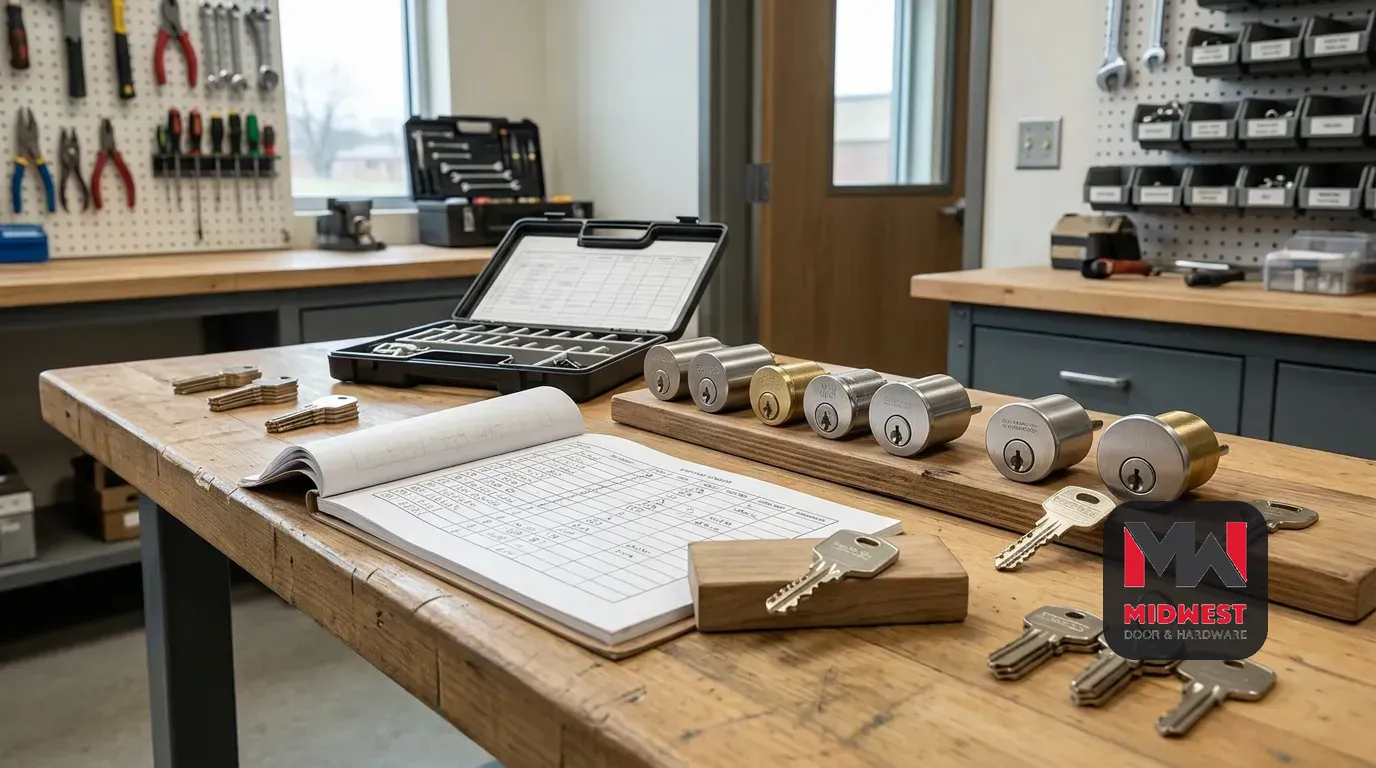
high security key
High-Security Keys for Commercial Buildings: A Nebraska Facility Decision Guide
Start with the control problem, not the key label
A high security key decision should begin with your facility’s control problem: who needs access, which openings each person may use, how duplication will be authorized, and how the hardware must work with the existing doors. The label alone does not decide whether a system fits a school, hospital, church, arena, office, or public building in Lincoln, Omaha, North Platte, Scottsbluff, or another Nebraska community.
High-security keys may use restricted keyways, patented profiles, side milling, embedded components, or specialized cutting methods. Those features can require authorized equipment and trained technicians, so duplication is handled differently from a conventional commercial key. These keys are designed to resist unauthorized duplication and reduce the risk of forced entry, covert entry, and keyway misuse. They do not, by themselves, establish that every door, user group, access policy, or fire-rated opening has been addressed.
A keyway is the shape of the interface between a lock and its key. That distinction matters during a facility review because the keyway connects the key-control decision to the cylinder, lock function, door preparation, and records already associated with the opening. Start by documenting what is installed before deciding what should replace or expand it.
Use this guide to make the decision in sequence: define the access hierarchy, compare mechanical control with electronic access, establish who may authorize future keys, test the plan against every opening, verify fire-rated compatibility, and assemble the information needed for a qualified review. The responsible choice is a controlled system that fits those conditions, not simply a more restricted key.
What makes a high-security key different from a conventional commercial key
A high-security key differs from a conventional commercial key mainly through its keyway design, duplication controls, and the equipment or authorization needed to produce another key. A restricted keyway system can connect locks and keys to a master key while limiting ordering to authorized dealers. Some patented systems require written consent from the building owner before a unique key blank can be obtained.
Restricted keys use patented keyways, and authorized dealers verify authorization before cutting copies. In some systems, patented protection or restricted distribution limits who can obtain the proper blanks. That control can be supported by a signature card, account verification, or direct approval from the registered system owner. The practical question for your facility is not whether a key is marked restricted; it is whether the authorization process is documented, assigned, and workable when staff, contractors, or departments change.
A high-security designation can relate to tamper resistance. A UL rating described for high-security hardware addresses resistance to picking, bumping, and drilling. Treat that description as one part of the specification rather than as a universal promise about every product sold under a high-security label. The particular cylinder, lock body, installation, door condition, and approved use still require review.
Key-control options can range from duplication being completely controlled by a local locksmith to duplication being completely controlled by the customer. Those are different administrative arrangements, even when both use restricted blanks. Before selecting a system, write down who may request a key, who approves the request, where the authorization record resides, and how returned or lost keys will be handled.
A restricted key can address duplication and keyway-control concerns, but it does not automatically provide electronic credentials, entry records, a new master-key hierarchy, or compatibility with an existing fire-rated assembly. Record the specific problem you want to solve before treating the key type as the solution.
Map users, doors, and access hierarchy
A master key system uses hierarchy: master keys open multiple locks, while individual keys open only specific locks. Master key systems configure keys for predefined entries and can reduce the number of keys in circulation. A single mastered key can unlock all or selected doors in a compatible system, but that result depends on the system design and the hardware receiving the cylinders.
Build the access map before you choose the hierarchy. Separate people by the openings they need rather than by job title alone, because a facilities director, principal, nurse, custodian, coach, contractor, or administrator may require different combinations of access. Record each group and its permitted openings in a working schedule.
Your access map should identify:
- Individual users or user groups and the doors each group needs.
- Doors that require a room key, a selective master key, or a broader master level.
- Openings shared by maintenance, emergency response, vendors, or building management.
- Doors that should not be included in a master level because their access needs are separate.
- Existing keys, cylinders, cores, lock functions, and records associated with each opening.
- The person responsible for approving changes to the hierarchy.
Use the map to test whether a proposed arrangement creates unnecessary master-key distribution or leaves a required opening outside the plan.
A mechanical hierarchy may fit a facility that wants predefined access through keys, while a different arrangement may be needed when permissions change often or several departments manage access. Do not assume that reducing the number of keys is the same as reducing access. The useful result is a hierarchy that gives each authorized group the openings it needs without extending access beyond the written plan.

Compare restricted mechanical control with electronic access
Restricted mechanical control and electronic access answer different operating needs. Electronic access control suits facilities that need frequent permission changes, electronic credentials, or entry records. A master key system may suit a facility that prefers a simpler mechanical arrangement. Use the shared criteria below to identify which operating model matches your building.
| Decision criterion | Restricted mechanical control | Electronic access |
|---|---|---|
| Permission changes | Changes are managed through the keying plan, authorized duplication, rekeying, or cylinder changes. | Frequent permission changes can be managed through electronic credentials when the system supports that function. |
| Credentials | The credential is a physical key tied to a cylinder and the approved keying hierarchy. | The credential is electronic, with the specific credential and system requirements needing review. |
| Entry records | A mechanical key arrangement does not by itself provide electronic entry records. | Entry records may be a reason to consider electronic access. |
| Operating model | A master key system may suit a simpler mechanical arrangement with predefined entries. | Electronic access may suit a facility that needs changing permissions, electronic credentials, or entry records. |
| Administration | Duplication control, authorization records, issuance tracking, and master-key distribution must be managed. | Credential administration, system configuration, and the facility’s electronic access procedures must be coordinated. |
Ask four questions before choosing between the two arrangements:
- How often will permissions change because of turnover, temporary assignments, vendors, or departmental moves?
- Do you need an electronic credential or an entry record for particular openings?
- Can your facility maintain a written mechanical key-control process, or does the operating model require electronic administration?
- Which existing doors and hardware can accept the proposed arrangement without unapproved field changes?
Choose the model that fits the operating requirement you can administer. Do not present mechanical or electronic access as universally superior.
Use the comparison as a scope test, not only as a product comparison. For each opening or user group, state whether the need is controlled physical duplication, a defined key level, frequent permission changes, an electronic credential, or an entry record. Then state what must remain coordinated with the existing door and hardware. This separates the problem the facility is solving from the mechanism used to solve it. It also gives the reviewer a usable handoff: preserve the current arrangement, revise selected cylinders, or evaluate an access-control change. If the operating requirement is not written down, a request for a high-security key can be evaluated against the wrong objective. Keep the decision criterion tied to what the facility needs to administer and document over time.
Decide who controls future duplication
Future duplication is part of the original restricted-key decision. Some specialized keys can be duplicated only by an authorized locksmith or security provider with the correct blanks, equipment, and manufacturer permissions. Some systems may require a signature card, account verification, or direct approval from the registered system owner. Establish those conditions before your facility issues the first key.
Use a written key-control policy that tracks issuance and limits master-key distribution. The policy should name the approving authority, identify the records that establish authorization, define how a request is submitted, and show how issued keys are recorded. It should also identify who receives notice when a key is lost, when an employee or contractor’s access ends, or when a cylinder is changed.
A provider should ask questions, verify the keying system, and confirm that a duplication request is legitimate before making a copy. The usual first step is identifying the keyway and the system it belongs to by checking the key stamp, reviewing associated records, confirming the registered owner, or inspecting the lock hardware. If the key is damaged or the system identity is unclear, do not treat a visible marking as sufficient authorization.
Include these controls in your review:
- The registered system owner and authorized representatives.
- The keyway, system name, key stamps, and available records.
- The approval needed for individual keys, master keys, and replacement keys.
- The location of signature cards, account records, or other authorization documents.
- The person who receives and reconciles issued keys.
- The response after loss, suspected compromise, termination, or an unexplained duplicate.
The boundary is direct: do not duplicate, substitute, or alter a restricted key or cylinder without authorization.

Test the plan against every commercial opening
A commercial opening review starts with identification, not ordering. Identify the keyway and its system by checking records, confirming the registered owner, and inspecting the lock hardware when necessary. Record the door, frame, cylinder, lock function, key stamp, handing where relevant, and any electrified or monitored features for each opening.
For each opening, compare the proposed hardware with the documented conditions:
- Door material and frame material: steel, aluminum, or wood.
- Existing cylinder, lock body, exit device, closer, strike, and preparation.
- Required keying level and relationship to neighboring openings.
- Electrified, monitoring, signaling, or access-control interfaces.
- Available templates, shop drawings, reinforcement details, and wiring provisions.
- Whether installation can proceed without additional field modification.
The goal is to find conflicts before release, fabrication, or installation.
Commercial cylinders are not interchangeable by label alone. The cited Lockwood Twin system offers cylinders for new and retrofit installations and for many commercial-grade hardware installations. For applications requiring a high-security cylinder to meet UL 437 requirements for pick and drill resistance, Yale offers the U5153 mortise cylinder and the U5109 rim cylinder. These examples identify product-specific conditions; they do not establish that either option fits your openings.
Release a keying or hardware selection only after the opening inventory, preparation requirements, system records, and access-control interfaces have been compared. If any of those records are missing, hold the selection for qualified review instead of making a field assumption.
Use a two-pass review. First, confirm the identity and condition of each opening and the system records associated with it. Second, compare the proposed component with the lock function, preparation, access-control interface, and applicable documentation. For a Nebraska project, determine preparation and coordination from the applicable contract documents, manufacturer requirements, adopted codes, and authority review. Keep those sources with the opening record so the team can distinguish a documented requirement from a field assumption.
Verify fire-rated compatibility before specifying hardware
A fire-rated assembly’s approved hardware schedule identifies the tested hardware for that particular door-and-frame combination, including manufacturers and model numbers. Use the schedule for each rated opening when reviewing a cylinder, lockset, exit device, closer, or electrified component. A general statement that hardware is fire-rated does not replace the assembly-specific schedule.
Hardware not explicitly approved for the door-and-frame combination can invalidate the fire door assembly’s overall certification, even when the hardware carries its own fire rating. That makes compatibility a release condition, not a detail to resolve after installation. Do not substitute a restricted cylinder or other hardware into a rated opening until the responsible review confirms that the complete assembly remains acceptable.
Compare the proposed keying plan with the rated opening’s documentation, lock function, preparation, reinforcement, and any access-control interface. Check the shop drawings and the door manufacturer’s approved hardware schedule together. The comparison should identify the manufacturer, model, fastening or preparation requirements, and the exact door-and-frame combination covered by the approval.
At Midwest Door & Hardware, we stock hollow metal doors, wood doors, hardware, fire-rated assemblies, and Division 10 items. That product scope can support a coordinated opening discussion, but the specific compatibility of a proposed keying component still belongs to the documented assembly review.
For a Nebraska school, hospital, church, arena, office, or public building, keep the fire-rated opening record with the keying and hardware schedule. If the record is incomplete or the proposed component is not listed, stop the substitution and obtain qualified review before changing the opening.
Where a project includes fire-rated or tornado-rated doors, identify the governing requirements before accepting a component. The review should account for NFPA 80, ICC 500 for designated storm shelters, FEMA-related requirements where applicable, and local building codes. These are review checkpoints, not a facility-specific compliance determination. The responsible authority and qualified professionals must confirm how they apply to the particular opening.
Plan maintenance, timing, and project cost
Maintenance planning belongs in the keying decision because commercial openings experience repeated use by staff, deliveries, and visitors. A door used dozens of times a day wears down mechanically faster than a home lock, so commercial hardware can need attention earlier than expected. We consider maintenance protocols essential to the long-term performance of commercial-grade doors.
For a Medeco or MUL-T-LOCK high-security key, duplication usually takes around ten minutes once identity verification and code location are included. That estimate describes a key-copy process, not the time needed to review a facility-wide key hierarchy, identify an unknown system, replace cylinders, or coordinate fire-rated and access-control requirements.
For one lock in a straightforward case, single-lock rekeying takes around 10–40 minutes, depending on the lock type, cylinder condition, and keying requirements. A multi-opening rekey, a system with uncertain records, or a project involving access-control coordination requires a separate review of scope and scheduling.
High-security lock installation pricing varies with lock type, security grade, and installation complexity. Service call fees typically apply, and per-lock pricing depends on whether one door or multiple entry points are being upgraded. A 2026 locksmith pricing range lists $500 or more for high-security commercial lock installation; the same range begins at $75 for a basic residential lockout, so its figures are not a quote for your facility. Location, time of day, service type, lock hardware, and door condition can also change the price.
For accurate pricing, have a qualified locksmith assess your property’s security needs and door condition. Prepare the opening inventory and keying records before that assessment so the estimate can distinguish a key copy, a single-lock rekey, a cylinder change, and a broader commercial installation.
Ask the provider to state whether the price covers only key duplication, a cylinder or rekey service, hardware replacement, or a coordinated installation. Also ask which assumptions depend on existing records, lock condition, door preparation, number of openings, service call, location, and time. This makes the reported range a comparison point rather than a promise. A facility should also ask how the proposed work affects future duplication and maintenance records. The resulting scope should identify what is known, what requires inspection, and what must be confirmed before work proceeds. When proposals use different labels, compare them by opening and decision rather than by product name. For each opening, mark the requested scope as key duplication, rekeying, cylinder replacement, hardware replacement, or access-control review. Then mark which records support system identity, authorization, fire-rated approval, and preparation, and which items still require inspection or authority review. This helps the facility distinguish a narrower quote from an equivalent scope instead of comparing prices without context. For every unresolved item, assign the next reviewer: the facility administrator for authorization records, the qualified door-hardware professional for opening compatibility and operation, and the responsible authority for applicable code or life-safety questions. Keep that disposition with the opening record.
After work is authorized, update the key schedule, issued-key record, master-key levels, and maintenance notes rather than treating the transaction as complete when the hardware arrives. Record who receives permanent keys or related materials, what was changed, and what future duplication process applies. If a proposed change affects only selected openings, identify the openings left on the prior arrangement. This preserves the distinction between a facility-wide system decision and a limited service call, and gives the next reviewer a usable record if access, operation, or authorization changes later. If the provider cannot state the scope and its assumptions clearly, pause comparison until the missing records or inspection questions are resolved.
A restricted key does not have one reliable service duration for every facility. Reliability depends on the key, cylinder, door use, condition, duplication quality, and maintenance program. High-security keys often require tighter tolerances than standard keys, and poor duplication can lead to intermittent operation, premature wear, or complete failure in the cylinder. Treat difficult operation as a maintenance issue rather than waiting for a complete lockout.

Assemble the facility review packet
A complete review packet lets you discuss the facility as a set of documented openings rather than as an abstract request for a restricted key. Assemble the records before requesting pricing, rekeying, expansion, or replacement.
Include the key and authorization records:
- Keyway, system name, key stamps, cylinder information, and available manufacturer records.
- Registered owner, authorized representatives, signature cards, account verification, or other approval documents.
- Current key schedule, issued-key list, master-key levels, and written limits on master-key distribution.
- Lost-key, terminated-access, returned-key, and rekeying records.
The usual identification process may involve checking records, confirming the registered owner, or inspecting the hardware. Give those materials to the reviewing provider rather than relying on memory.
Include the opening and compliance records:
- Door and frame material, opening number, cylinder, lock function, exit device, and existing preparation.
- Fire-rated door-and-frame schedules with approved manufacturers and model numbers.
- Shop drawings, templates, reinforcement details, and applicable pre-wiring information.
- Access-control, monitoring, signaling, and credential requirements.
- The access hierarchy showing individual, selective master, and broader master access.
The fire-rated schedule and the opening inventory should be reviewed together because approval applies to the particular door-and-frame combination.
A public door-hardware specification delivers permanent keys, cylinders, cores, access-control credentials, software, and related accessories directly to the owner when applicable, with delivery instructions established at a keying conference. Use that as a coordination question for your project: identify who receives permanent materials, how delivery is documented, and when the owner’s instructions are established.
Ask the reviewing provider to address these points in writing:
- Does the proposed keyway and cylinder fit each listed lock function and opening preparation?
- Which users receive individual keys, master keys, or electronic credentials?
- Who may authorize future duplication, replacement, rekeying, or master-key changes?
- Which fire-rated schedules approve the proposed hardware for each rated opening?
- What records, templates, shop drawings, and delivery instructions are needed before release?
- Which maintenance and response steps apply if a key is lost or operation changes?
A written packet makes unresolved decisions visible before hardware is ordered or modified.
Act promptly when access or operation changes
A lost restricted key or an access-concerning termination requires prompt action. Rekey immediately after any key loss or termination where access is a concern. Start by notifying the person responsible for the facility’s key-control policy, preserving the relevant records, and contacting an authorized provider for a system-specific response.
Difficulty turning a key is an early and common symptom of a developing commercial door-lock fault. If you struggle to turn your key, take notice rather than forcing the key, continuing normal use without review, or replacing a component based only on appearance. Record the opening, key, cylinder, and operating condition and arrange qualified assessment.
Take these first steps when access or operation changes:
- Identify the affected opening and the key or user involved.
- Preserve the key-control, authorization, and access records.
- Notify the responsible facility administrator when a loss or termination affects access.
- Contact an authorized commercial provider when duplication, rekeying, or hardware condition is uncertain.
- Keep the opening in its documented condition until the appropriate review determines the next action.
Do not duplicate a restricted key without authorization, force a difficult key, or field-modify hardware in a fire-rated or access-controlled opening.
Urgency does not remove the need for control. A prompt response should still preserve authorization, compatibility, and the existing opening record.
Request qualified review when the opening record is incomplete
A commercial locksmith can install, repair, and upgrade commercial door locks, master key systems, high-security locks, and electronic access-control systems. A commercial locksmith can also evaluate existing doors, recommend suitable security hardware, repair damaged locks, install new locking solutions, and help maintain reliable access throughout a property.
Request qualified review when any of these conditions remains unresolved:
- The keyway, system owner, or authorization record cannot be identified.
- The planned hierarchy does not clearly assign each user group to its required openings.
- The facility is deciding between mechanical keying and electronic access without a documented operating requirement.
- The proposed cylinder or lock function has not been matched to the existing hardware and preparation.
- A fire-rated assembly’s approved hardware schedule is missing or does not list the proposed component.
- Access-control, monitoring, signaling, templates, reinforcement, or pre-wiring requirements are unclear.
- A key is lost, access has changed, or the key is difficult to turn.
Give the provider the facility review packet rather than asking for a generic restricted key. The packet should show the existing system, openings, users, access hierarchy, fire-rated documentation, shop drawings, preparation requirements, key-control policy, and the specific decision you need to make. This allows the review to separate a key-copy request from a rekey, cylinder replacement, access-control change, or coordinated opening project.
Do not treat an incomplete record as permission to substitute hardware. Pause the selection and obtain the review needed to resolve security, life-safety, access-control, and compatibility questions before altering the opening.
Move forward with the opening information ready
A restricted mechanical key system is worth considering when controlled duplication and a defined mechanical hierarchy fit the facility’s operating needs. The decision is responsible only after you map users and openings, compare mechanical and electronic access requirements, establish future duplication controls, test the hardware against each opening, and match every proposed component to the applicable fire-rated documentation.
Put the keyway records, ownership authorization, opening inventory, access hierarchy, fire-rated schedules, access-control requirements, drawings, delivery questions, maintenance information, and written key-control policy in one review packet. A qualified professional should decide facility-specific suitability, and unresolved security, life-safety, accessibility, or compatibility questions should be directed to the responsible authority before hardware is changed.
For a facility in Lincoln, Omaha, North Platte, Scottsbluff, Grand Island, or elsewhere in Nebraska, that preparation gives you a clear basis for deciding whether to pursue a restricted mechanical system, coordinate electronic access, rekey selected openings, or defer the change until the documentation is complete.
What should a facility provide before requesting a high-security key review?
When should a commercial high-security key problem be treated as urgent?
Act promptly after a key is lost, an employee or contractor’s access ends, or access may be compromised. Difficulty turning a key is also an early sign of a developing lock fault. Notify the facility’s key-control administrator, preserve the system records, and contact an authorized commercial provider. Do not force the key, make an unauthorized copy, or keep using a failing opening without review.
Can a high-security cylinder be added to an existing fire-rated door?
Not automatically. The proposed cylinder and related hardware must match the lock function, door preparation, and the approved hardware schedule for that specific fire-rated door-and-frame assembly. Hardware that is not approved for the complete assembly can affect its certification. Obtain qualified review before substituting or modifying any component.
How long does a commercial high-security key project take?
Copying an identified key may take around ten minutes after authorization and code verification. A straightforward single-lock rekey often takes about 10–40 minutes.
What information should be included when requesting a high-security key quote?
Provide the keyway and system records, registered owner and authorization details, opening inventory, existing cylinders and lock functions, access hierarchy, fire-rated schedules, access-control requirements, shop drawings, preparation details, and key-control policy. Ask the provider to separate pricing for copying, rekeying, cylinder replacement, and broader installation so the scope and assumptions are clear.
What does a commercial high-security key system cost in 2026?
There is no reliable single price for a facility-wide system. A qualified provider should assess the openings and records before preparing a property-specific estimate.
Start Your Build
Got a project? We'll bring frames, doors, hardware, and the expertise to keep every opening on schedule.