
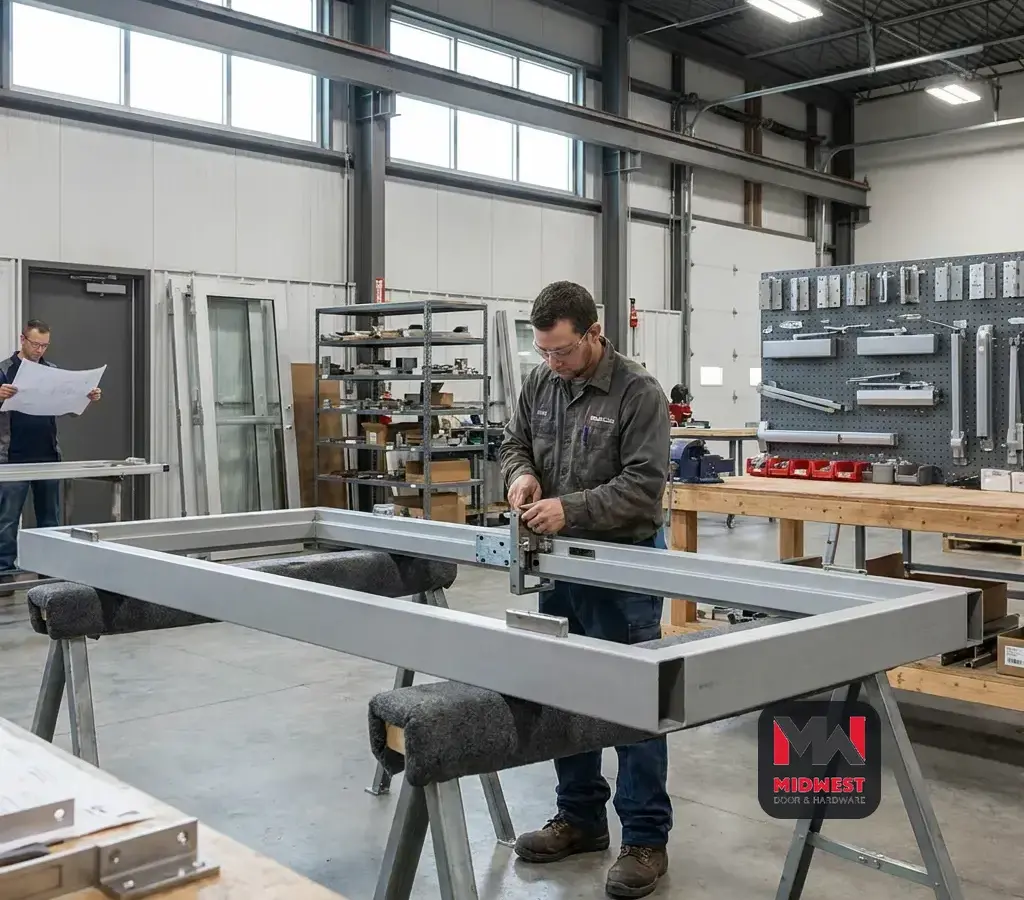
custom service hardware
Custom Service Hardware for Secured Commercial Openings: What to Clarify
Commercial door hardware in a secured-opening context
For a secured commercial opening, this discussion concerns commercial door hardware. Commercial door hardware is designed for commercial applications, including retail shops, multifamily housing, and businesses. Cabinet and consumer hardware fall outside this commercial-door subject.
The category names relevant here are hinges, locks, exit devices, door closers, and electrified hardware. A category name identifies the type of hardware being discussed; it does not state a model, configuration, or compatibility determination. These names are distinct from a description of the opening and from the project conditions around it. Keeping those kinds of information separate helps prevent a product-category label from being treated as a complete description of an opening.
The opening itself includes the door, frame, hanging hardware, closer, latch, strike, trim, and any electrified hardware. Material, frame preparation, opening size, traffic, exposure, security needs, and required function describe conditions relevant to the discussion, rather than additional product categories. These factors may differ between openings even when the same hardware category is being discussed.
Electrified hardware brings coordination subjects such as readers, controllers, wiring, electrical rough-in, voltage, and documentation into view. Keying concerns owner instructions and a schedule when the project specification requires one. Those subjects relate to the opening but are distinct from the names of its hardware categories.
The useful distinction is among the kind of hardware, the complete opening where it is used, and the conditions or coordination topics that apply to the project. Each describes a different part of the commercial-door context.
Commercial door hardware categories
Commercial door hardware includes hinges, locks, exit devices, door closers, and electrified hardware. Each name identifies a category, not a complete set of requirements for an opening.
- Hinges: A category of hanging hardware.
- Locks: A category that includes locks or locksets.
- Exit devices: A separately named hardware category that may be part of an opening’s hardware scope.
- Door closers: Another category that may be included in the opening’s hardware package.
- Electrified hardware: A category to distinguish when electrical components are part of the opening.
These names are useful for identifying what kind of hardware is being discussed, but they do not establish a particular product, arrangement, or compatibility. Nor does the presence of one category tell you which other components are present. A lock, for example, is one part of an opening that may also include a door, frame, hanging hardware, closer, latch, strike, trim, or electrified hardware. The category and the surrounding assembly are related descriptions, not interchangeable ones.
Some openings may involve more than one of these categories, while a project discussion may concern only one. The names alone do not say whether a category is required, how it should be configured, or whether it works with the other parts. Those questions depend on project-specific details and review by the responsible project participants. When a category is uncertain, the opening and known components provide context without requiring a guessed product specification.
Keying is a separate subject from this list of hardware categories. It concerns instructions and, when required by the project specification, a schedule and its approval sequence. Keeping keying distinct prevents a category name such as “lock” from being mistaken for a settled keying plan.
Discuss the complete opening rather than one part
Treat the door, frame, hanging hardware, closer, latch, strike, trim, and any electrified hardware as one opening. This keeps a hardware question connected to the assembly where the parts are used, rather than limiting the discussion to a single item.
If you are asking about a lock, identify the opening it belongs to and mention related components you know about. If the question concerns electrified hardware, describe the door and frame along with the electronic components involved. You do not need to turn that description into a final selection; the purpose is to give the conversation enough context to address the opening as a whole.
A request that names only one part can leave important context unstated. Clarify which part you are asking about, which opening it serves, and what other hardware is present or included in the project. If you do not know a component’s name, describe its location or note it as unidentified. That gives you a more accurate way to raise the question without assigning the component a specification.
Describe the opening conditions that matter to the discussion
The opening’s physical conditions and intended use belong in a hardware discussion. Hardware selection should account for the door material, frame preparation, opening size, traffic, exposure, security needs, and required function. Share the details you know as context for supplier guidance, not as a formula for choosing a product.
For each opening, gather the information you can describe:
- Door material: Identify the material of the door under discussion.
- Frame preparation: Share what you know about how the frame is prepared for hardware.
- Opening size: Provide the size information available for that opening.
- Traffic and exposure: Describe how the opening is used and the conditions it is exposed to.
- Security needs: State the security purpose the opening needs to serve.
- Required function: Explain what you need the opening to do in the project.
If a detail is unknown, leave it open rather than filling it in by assumption. You can distinguish a confirmed condition from a question that still needs resolution. That difference matters: a supplier conversation can start with the information you have, but an unanswered question should not be presented as a settled product requirement.
For a Lincoln-area project, tie the description to the actual building and opening rather than relying on a generic hardware label. The same category name can be part of different project discussions depending on the opening’s use and the conditions you describe.

Record opening details when the project has multiple doors
For multiple doors, record each opening’s location, use, door material, frame, handing, swing, and observed condition, along with its hardware and any electrified hardware. Separate entries help you describe the actual scope instead of treating the building’s doors as interchangeable.
A short inventory can use one row or entry per opening. Include:
- Location and use.
- Door material and frame.
- Handing, swing, and observed condition.
- Hardware you can identify, including any electrified hardware.
When you can name existing components, include them. The hardware may include hinges or pivots, a closer, a lock or exit device, trim, a strike, or electrified components. If you cannot identify a part, mark it as unidentified instead of guessing. Keep each observation tied to the opening where you made it.
Use the inventory to show which openings are included and where you have different information or open questions. For example, if two doors have different uses or observed conditions, keep their entries separate rather than combining the details into one description. This makes it easier to discuss the actual project scope without implying that the openings share a configuration.
The inventory is a communication aid, not a product selection or complete specification. It helps you organize known opening details and identify what still needs discussion. For a project with multiple doors, that distinction can keep the inquiry focused on the openings in scope rather than on an assumed standard set.
Distinguish openings by their intended use
For multiple doors, group openings by function, such as public entry, staff-only, service, stair, or emergency use. Grouping by use helps you communicate where project questions differ, even when several openings are in the same building.
Use the function labels that fit your project. A public entry and a staff-only opening, for instance, can sit in separate groups when their requirements need separate discussion. The same applies to service, stair, and emergency-use openings. Do not assume that doors share project needs simply because they are close together or have similar hardware.
Add the function to each opening’s inventory entry, then use it to organize the discussion. If an opening serves more than one relevant use, or its role is unclear, describe that uncertainty directly. Keep the opening’s function distinct from the hardware category: the function explains the context for the discussion, while the category identifies the type of hardware being raised.
Coordinate access-control components and electrical details
An electrified opening calls for coordination across physical hardware, readers, controllers, wiring, and electrical rough-in. Identify who is responsible for each part and when the rough-in needs to be ready, including before walls close.
For your project discussion, separate the responsibilities into clear questions:
- Who is handling the physical door hardware?
- Who is handling readers, controllers, and wiring?
- Who is coordinating the electrical rough-in and its timing?
One described trade arrangement assigns physical hardware to the door and hardware contractor, readers, controllers, and wiring to the low-voltage or security contractor, and electrical rough-in before walls close to the general contractor. Use those topics to coordinate responsibilities with your project team; establish the actual assignments for your project rather than assuming that the same arrangement applies everywhere.
Keep the physical hardware and electronic components connected in the opening record, but distinguish who is supplying or installing each part. A list of hardware categories does not answer that responsibility question. If the assignment or timing is still unsettled, make it an open coordination item.
Voltage, wiring details, and electronic-component documentation are also coordination topics for an access-controlled opening. The cited door-hardware specification calls for coordinating voltages and wiring details with related sections, and for including wiring diagrams and instructions for electronic components in project documentation.
When you prepare your project notes, identify the electrified openings and raise the voltage, wiring, diagram, and component-instruction details with the responsible participants. Keep these questions tied to the openings they concern. That way, your hardware discussion can identify the electrical coordination needed without treating a category name as an electrical design decision. The cited specification also distinguishes manufacturer-installed wiring from field-installed wiring, so this is a separate coordination question to raise rather than leaving the installation boundary implicit. For each unique access-controlled opening, it calls for an elevation diagram showing the location and interconnection of major system components in that opening. It also calls for complete riser and point-to-point access-control system block-wiring diagrams, plus wiring instructions for each electronic component. These are documentation items to raise with the project team, not a determination of what equipment or wiring a particular opening needs. Keeping this information tied to the opening it describes lets the team discuss component location, interconnections, and wiring instructions without treating the word “electrified” as a complete system description.
Settle keying instructions before permanent components are ordered
Keying is a separate project question from the list of hardware categories. Where the project specification requires it, clarify the owner’s keying instructions and obtain approval of the keying schedule before permanent cylinders or cores are ordered.
Raise the sequence with the project participants:
- Who will provide the owner’s keying instructions?
- Does the project specification require a keying schedule?
- Who will approve the schedule?
- When must that approval happen in relation to ordering permanent cylinders or cores?
The specification-dependent sequence matters: address the instructions and schedule before ordering the permanent components when that requirement applies. Keep the open questions visible if instructions, schedule requirements, or approval responsibilities are unresolved. Do not imply that identifying a lock or other hardware category has settled the keying plan.
For a multi-opening project, connect keying questions to the openings and instructions they concern. Your notes can distinguish the hardware being discussed from the owner’s direction about keying. That separation gives the inquiry a clear scope while leaving project-specific instructions and approvals with the people responsible for them. The cited specification describes a separate keying schedule prepared after a meeting with the owner and submitted electronically. It calls for a keying-system explanation, door numbers, key-set symbols, hardware-set numbers, and special instructions, and requires owner approval before permanent cylinders or cores are ordered. These fields connect owner direction with specific doors and hardware sets under discussion; the phrase “key these doors” alone does not record that schedule information. The schedule and access-control drawings serve different documentation purposes: one captures keying instructions and references, while the other covers component locations and electrical interconnections. Confirm which requirements apply under the project specification, and keep unresolved instructions visible rather than assuming a standard format or settled plan.
Leave regulated opening decisions to project review
Fire-rated, egress, and accessible openings need project-specific review under adopted requirements and by the authority having jurisdiction. A general description of the hardware does not settle those opening decisions.
If one of these conditions applies, identify the opening and flag the review in your project discussion. Keep an unresolved requirement visible rather than treating a category name, inventory entry, or supplier conversation as approval. This boundary concerns the opening’s project review; it does not prevent you from describing the door, its use, and the hardware involved.
What “custom service hardware” means in this context
Commercial door hardware is designed for commercial applications, including retail shops, multifamily housing, and businesses. Cabinet hardware is a separate product category; this article focuses on commercial doors.
If your project covers several doors, organize the details by opening and function. Separate what you know from what remains a question, then identify whether each question concerns hardware, electrified components, or keying. For fire-rated, egress, or accessible openings, leave the project-specific review with the responsible project participants and authority having jurisdiction. With that context in hand, you can make a focused inquiry about the opening and the commercial door hardware under discussion.
Common questions about the term and categories
What does “custom service hardware” mean for a secured commercial opening?
The phrase is broad and does not identify a product or specification. For a commercial door project, clarify which opening and hardware categories you mean; cabinet and consumer hardware are outside that scope.
What should I do if I cannot identify a door hardware component?
Describe the opening and the component’s location, and mark the part as unidentified. Keep that observation separate from confirmed requirements rather than guessing at a product or configuration.
How should I handle hardware questions that apply to several doors?
Keep a separate record for each opening, including its use and known conditions, and group openings by function when that helps organize the discussion. This avoids assuming that doors share the same needs or hardware.
Start Your Build
Got a project? We'll bring frames, doors, hardware, and the expertise to keep every opening on schedule.