
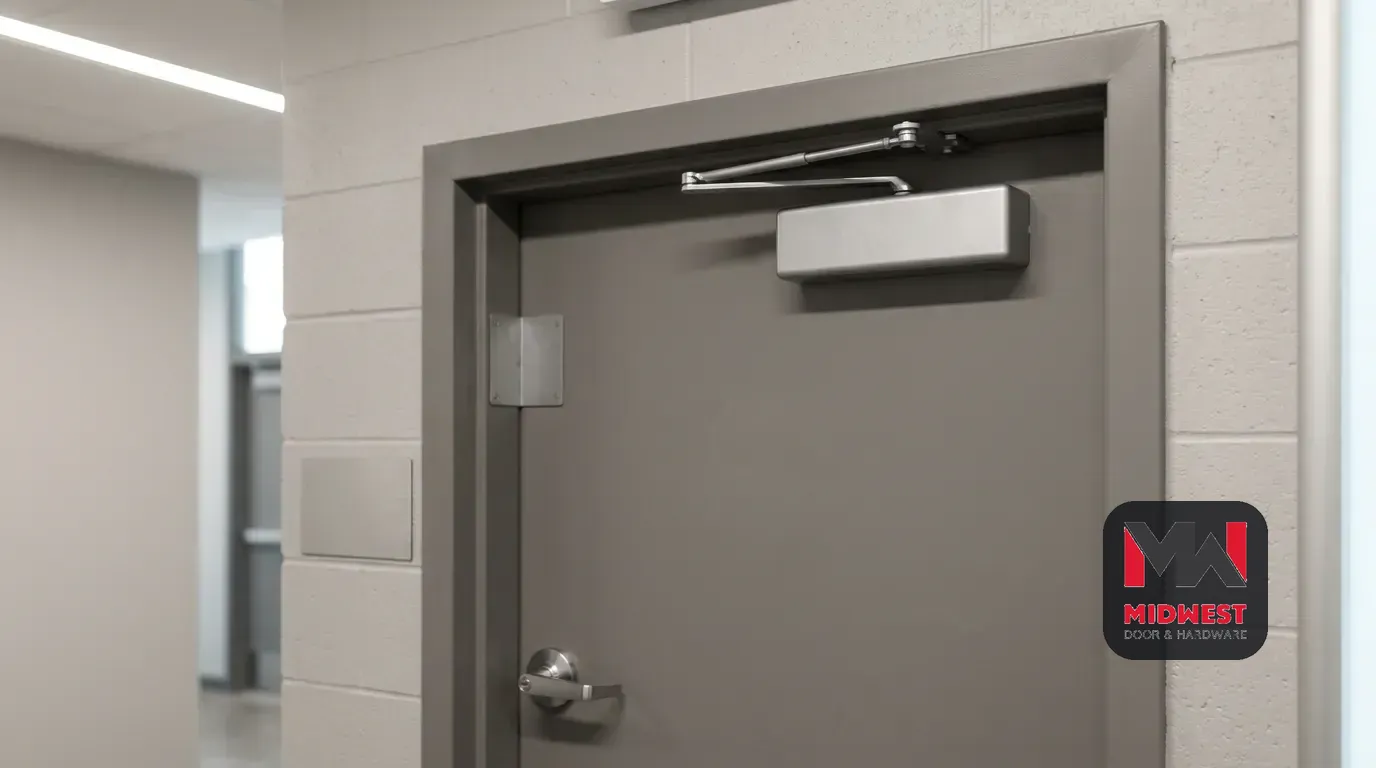
door closer settings
Door Closer Settings: Match the Behavior to the Function
Read the behavior as a clue, not a diagnosis
A commercial door closer’s movement can help you identify which function to inspect, but a symptom alone does not identify the cause. Start by noticing when the behavior occurs: during the longer closing swing, in the final movement toward the latch, or as the door opens toward its maximum swing. Those phases point to different closer functions.
Most commercial door closers have separate adjustments for closing speed, latching speed, and backcheck. Common markings are “S” for swing speed, “L” for latch speed, and “BC” for backcheck. The labels are clues, not a diagnosis of the opening.
For a Lincoln, Nebraska project, record what you observe before deciding what to do. Keep the description specific: “moves quickly through most of its closing travel” is more useful than “closer is wrong.” That distinction helps you connect the behavior to a function without assuming the valve is the cause or that every closer has the same controls.
Use the door’s movement as a simple observation guide:
- If the door moves too quickly across the longer closing travel, note the swing or main closing-speed function.
- If the issue appears in the short final movement toward the latch, note the latching-speed function.
- If you feel resistance as the door opens toward its maximum swing, note backcheck as a possible function to investigate.
These are starting points for identifying what to check. They do not establish that a setting is incorrect, that an adjustment is available, or that changing it will resolve the problem.
Separate the main swing from the final latch
Swing speed and latch speed refer to different parts of the closing movement. Swing speed concerns the longer travel; latch speed concerns the short final movement toward the latch. On closers marked with these common symbols, “S” refers to swing speed and “L” to latch speed. These terms name functions, not hardware components that must be adjusted together. They also describe roles in the movement, not a universal control layout. Common markings do not guarantee that every closer has a separate adjustment for each function or uses the same label. The model’s instructions establish what controls are present; a shared abbreviation cannot substitute for that product-specific information.
That difference gives you a useful way to describe what you see. A door that moves quickly through most of its travel raises a different question from one that slows or behaves differently only at the end. If the door reaches the frame but does not latch, the final movement may be relevant to inspect. Neither observation proves that its corresponding valve is the cause.
Describe the phase rather than jumping straight to a setting. Note whether the behavior is consistent, where it begins, and whether the door completes its movement to the latch. This keeps the problem statement tied to what you can observe, rather than to a repair conclusion you have not established.

Understand resistance during opening
Backcheck concerns resistance as the door opens toward its maximum swing; the common marking is “BC.” If the opening feels restricted near that point, backcheck is a function to identify and investigate. That observation does not show by itself that the closer is responsible, and resistance at another point in the opening should not automatically be assigned to backcheck.
Keep the point of resistance in your description. “Resistance increases near the widest opening” gives you a more specific observation than “hard to open.” If the resistance happens earlier, varies, or accompanies a different problem, note that too. The model instructions—not a generic label—are the reference for what controls are present and what adjustments are permitted.
A commercial-door guide describes the ADA closing-speed measurement as applying to the main sweep from 90 degrees to 12 degrees. That description identifies a particular portion of closing travel; it is not, on its own, a determination that a specific opening meets the requirements that apply to your project. If a project requirement or compliance question is involved, use the applicable project information and involve a qualified professional when needed.
Treat spring power as a separate function
In commercial door closers, a spiral coil spring sits inside the body; spring power refers to compression of that spring. As the door opens, the spring compresses and stores energy. As the door closes, the spring decompresses and helps force the door closed.
Spring-power adjustment is not present in every closer. Some closers have fixed spring power and no spring-tension adjustment; most have adjustable spring power with an adjustment nut. Do not assume that a control exists because another closer has one, or that spring power explains a particular symptom.
If you are considering spring power, first identify the model and check its instructions for the available controls and permitted work. Keep the reason for the check tied to the observed behavior, but do not treat that behavior as proof that the spring setting needs to change. The available adjustment, if there is one, depends on the specific closer.

Verify the closer model before interpreting its labels
Closer labels and available adjustments depend on the model, so identify the unit before treating a marking as an instruction. “S,” “L,” and “BC” are common symbols for swing speed, latch speed, and backcheck, but a closer may not have every adjustment. Spring power may be fixed or adjustable as well.
Use the model information to locate the manufacturer’s instructions for that closer. The instructions are the reference for identifying its controls and for determining which adjustments the manufacturer permits. A description that fits another closer is not a substitute for those model-specific directions.
Before you decide whether to adjust anything, collect a few useful details:
- The closer’s manufacturer and model, if identifiable.
- The marking or control that appears relevant.
- The point in the opening or closing movement where the behavior occurs.
- What the door does at the end of its movement, including whether it reaches the latch.
- Any visible condition that may affect the closer or the opening.
This note gives you a clear description to use when checking the model instructions or asking for qualified service. It is not a universal adjustment sequence, and it does not replace the manufacturer’s directions.
Inspect the whole opening before blaming a setting
A closer setting is not the only possible explanation for unexpected movement. Look at the closer and its connection to the opening before deciding that a valve is the problem. Oil on the closer body or below it is a specific warning sign: the cited guidance says a leaking closer cannot be corrected by adjustment and needs replacement. Oil loss also reduces hydraulic resistance and can make closing behavior unpredictable; guidance ties leakage to a failed seal. A separate limit condition occurs when an adjustment reaches its endpoint but the door still behaves incorrectly. Guidance identifies an exhausted adjustment range if the sweep valve is fully closed and the door still slams, or the latch valve is fully open and the door still does not latch; in those cases, the hydraulic mechanism is described as worn or depleted. These endpoint conditions are narrower than simply observing a fast swing or a missed latch. Without the stated valve position, either symptom alone does not establish that the mechanism is worn or its adjustment range exhausted. Oil below the body, an endpoint with persistent behavior, and a general movement complaint are different observations; the first two have specific mechanical significance in the guidance, while the last is not a diagnosis. Keeping those signs distinct clarifies why another setting change may not address a leak or an exhausted range.
A bent closer arm or loose mounting can affect the closer’s performance. If you find either condition, the cited guidance is to fix the mounting or replace the arm before adjusting the valves. In other words, do not use a valve adjustment to stand in for addressing a visibly damaged arm or loose mounting.
A door, hinge, frame, or latch issue can also affect whether the door latches. A sagging door, swollen frame, or bent latch bolt can prevent latching regardless of the latch-valve setting. Inspect the door, hinges, and latch before concluding that the closer needs adjustment.
This matters when the door reaches the frame but the latch does not engage: the behavior alone does not tell you whether the closer or another part of the opening is responsible. Keep your note focused on the observed result, then distinguish any visible opening condition from a possible closer-function issue. These are examples to check, not a complete diagnosis of every cause of poor operation.
Choose a careful next step for the opening
If the closer is leaking, the arm is bent, mounting is loose, or the door or latch appears misaligned, address that condition rather than assuming a setting change is the answer. When operation or a project requirement is in question, have a qualified professional assess the opening. A symptom-to-function match can help you frame the issue; it cannot establish an individual compliance or safety determination.
At Midwest Door & Hardware, we offer repair and maintenance services designed to help contractors address door issues. A clear note about the observed behavior and closer model can give you a practical starting point for discussing the opening.
Practical questions about door closer settings
What are the three common adjustments on a commercial door closer?
They are usually closing or swing speed for the longer closing travel, latch speed for the final movement toward the latch, and backcheck for resistance as the door opens toward its maximum swing. Not every closer has all three, so verify the model and its instructions.
What do the L, S, and BC markings mean on a door closer?
“S” commonly marks swing speed, “L” latch speed, and “BC” backcheck. Markings and controls can vary by model; use the manufacturer’s instructions to confirm what a specific closer’s labels mean.
What should I check if a door reaches the frame but does not latch?
The final closing movement may make latch speed relevant, but the symptom does not establish that the closer setting is the cause. Inspect the door, hinges, frame, and latch for conditions such as sagging or a damaged latch bolt, and check the closer model’s instructions before deciding on an adjustment.
When should I stop considering an adjustment and seek service?
Do not treat oil leaking from the closer as a setting problem; the cited guidance says a leaking closer needs replacement. A bent arm, loose mounting, visible door or latch problems, or operation that raises a safety or project-compliance concern also calls for addressing the underlying condition or having a qualified professional assess the opening.
Start Your Build
Got a project? We'll bring frames, doors, hardware, and the expertise to keep every opening on schedule.