
Door Hardware
Door Hardware 101: Hinges, Closers, Locksets and Panic Devices
Walk up to any commercial door and you're looking at a carefully coordinated system of hardware components. Most people reach for the handle without giving any of it a second thought. But for contractors specifying and installing commercial openings, every piece of that hardware represents a decision — and getting those decisions right is what separates a smooth project from a costly one.
This is a practical introduction to the core hardware components found on commercial doors — what they are, how they work, and what to watch for when specifying them.
Hinges: The Foundation of Every Opening
It's easy to overlook hinges. They're not the most glamorous component on a door — but they are among the most critical. A hinge failure doesn't just affect the door. It affects the entire opening, and in high-traffic commercial environments, the consequences of an undersized or improperly specified hinge can show up fast.
Commercial hinges are rated by their frequency of use. A standard commercial hinge is typically rated for around 1 million cycles. For high-traffic openings — school corridors, hospital entries, exterior doors on busy buildings — a heavy-duty hinge rated for significantly more cycles is the right choice.
Most standard commercial doors use three hinges per door leaf. Taller or heavier doors may require four. Hinge size, weight rating, and finish all need to be matched to the door, the frame, and the application. Brands like McKinney produce hinges across a wide range of specifications to meet virtually any commercial requirement.
Continuous hinges — sometimes called piano hinges — run the full height of the door and distribute load across the entire length rather than at three discrete points. They're an excellent choice for high-abuse environments like school corridors, detention facilities, and exterior openings where door alignment and long-term durability are priorities. A continuous hinge essentially eliminates the sagging and misalignment that can develop over time with standard hinges on heavily used doors.
Door Closers: Keeping Doors Controlled and Code-Compliant
A door closer does exactly what the name suggests — it controls the closing speed and force of a door to ensure it closes fully and latches every time. On fire-rated openings, a closer isn't optional. NFPA 80 requires that fire doors be self-closing and positive-latching, which means a functioning door closer is a code requirement, not a preference.
Beyond fire-rated openings, closers are standard on most exterior commercial doors and many interior openings where controlled closing is important for security, energy efficiency, or simply preventing doors from slamming.
Specifying the right closer involves matching the closer's size — rated by a numerical scale from 1 to 6, with higher numbers indicating more closing force — to the door size, weight, and application. An undersized closer on a heavy exterior door won't hold up. An oversized closer on a light interior door creates ADA compliance issues, since closing force requirements for accessible doors are strictly limited.
There's also a wide range of closer types and mounting configurations to consider — standard arm, parallel arm, top jamb, and concealed closers all have their place depending on the door type and the architectural intent.
Locksets and Mortise Locks: Security at the Opening
The lock is the most visible security component on any door, and in commercial construction there's a significant range of options depending on the level of security required and the nature of the opening.
Cylindrical locksets — the most common type in light to medium commercial applications — mount through a cylindrical hole bored through the door. They're cost-effective, widely available, and appropriate for many interior office, classroom, and light commercial applications. Brands like Sargent and Best offer cylindrical locksets across a wide range of functions and security levels.
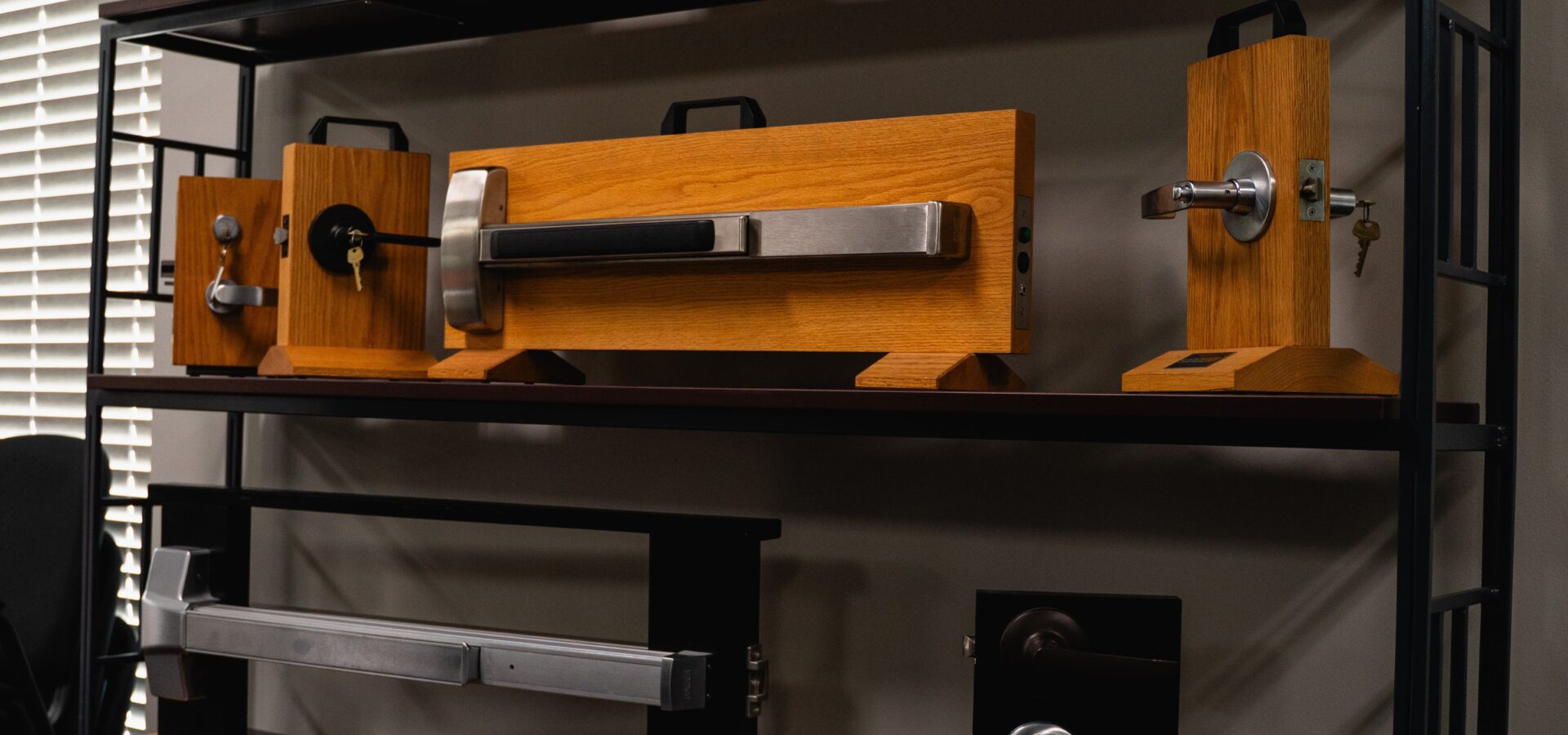
Mortise locks are the heavy-duty standard for commercial openings that see significant use or require higher security. A mortise lock is installed in a pocket — or mortise — cut into the edge of the door, and integrates the latch, deadbolt, and often additional functions into a single robust mechanism. Mortise locks are more durable than cylindrical locksets under heavy use and are the preferred specification for exterior doors, high-traffic corridors, and openings in healthcare, education, and government facilities.
Function matters as much as hardware type. Classroom function, office function, storeroom function, exit function — each describes a specific combination of how the lock operates from the inside and outside. Getting the function right for each opening is a critical part of the hardware schedule.
Panic Hardware and Exit Devices: Life Safety at the Exit
Panic hardware — also called exit devices or crash bars — is required by building codes on most commercial exit doors. The requirement exists for one straightforward reason: in an emergency, people push toward exits. Panic hardware is designed to release the door immediately under direct pushing pressure, without requiring the user to operate a handle, turn a knob, or perform any other secondary action.
The code requirements for panic hardware are found primarily in IBC (International Building Code) and NFPA 101, the Life Safety Code. Generally speaking, panic hardware is required on doors in assembly occupancies with an occupant load of 50 or more, and on all exit doors in educational and certain other occupancies regardless of occupant load.
Panic hardware comes in several configurations — rim devices, vertical rod devices, and mortise devices — each suited to different door and frame types. Rim devices are the most common and mount directly to the surface of the door. Vertical rod devices extend rods to the top and bottom of the door to engage strikes at both points, which is common on pairs of doors where one leaf needs to be secured at the top and bottom rather than at the latch edge.
Fire-rated panic hardware is a specific category — not all panic devices are rated for use on fire-rated openings, and specifying a non-rated device on a fire-rated exit door is a code violation. This is one of the most important distinctions to get right on any project with fire-rated exit openings.
Putting It All Together
What makes commercial door hardware complex isn't any single component — it's the way all of them have to work together. Hinges sized for the door weight. A closer matched to the door size and ADA requirements. A lockset or mortise lock with the right function for the opening. Panic hardware rated for fire where required. And all of it coordinated with the door prep and frame reinforcements so everything installs cleanly.
That coordination is what a hardware schedule is for — and it's one of the things MDH does best. Our team reviews hardware specifications opening by opening, makes sure every component is appropriate for its application, and helps contractors and building owners avoid the costly mistakes that come from hardware that doesn't work together the way it should.
If you're working through a hardware schedule or want a second set of eyes on a specification, reach out. We're glad to help.
Start Your Build
Got a project? We'll bring frames, doors, hardware, and the expertise to keep every opening on schedule.