
hardware suppliers near me
How to Choose a Commercial Door Hardware Supplier for a Nebraska Project
Use the inquiry as the supplier-fit test
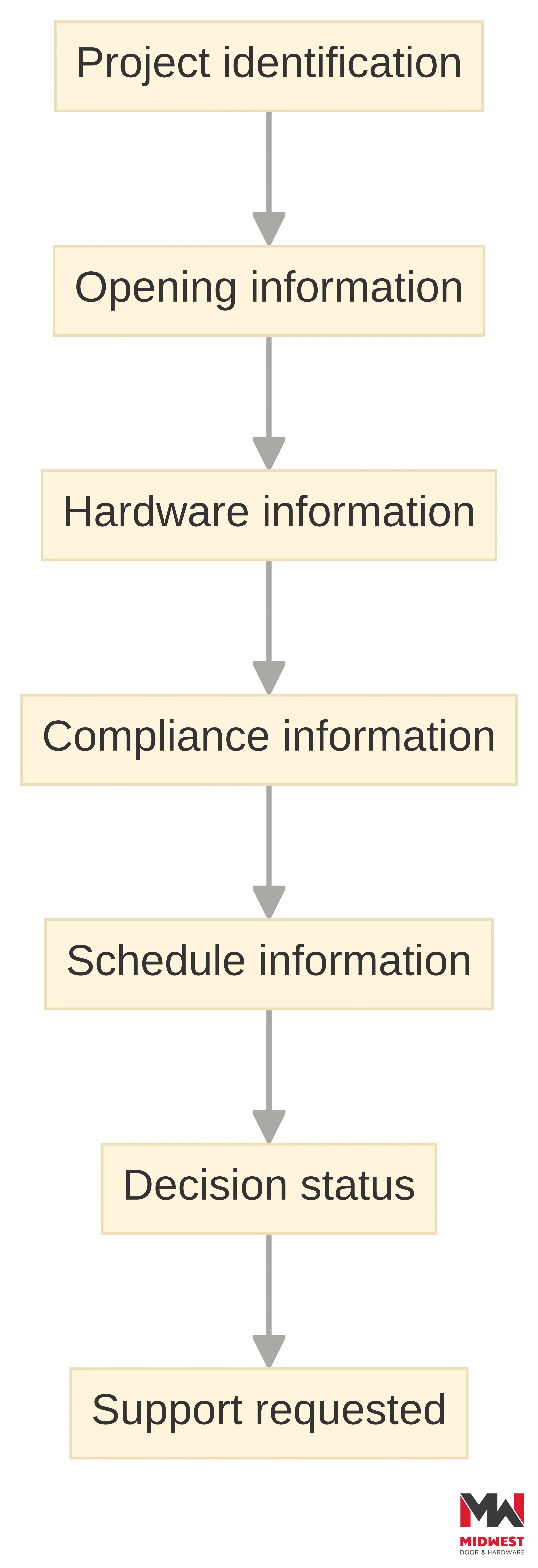
The initial supplier inquiry is a practical test of whether a commercial door hardware supplier can engage with your project as a coordinated opening package rather than a list of isolated products. Give the supplier enough information to understand the project, each opening, the hardware requirements, the applicable compliance questions, the schedule, and the type of support you need. The response can then show whether the supplier is prepared to work from project information instead of guessing from a product name.
For a school renovation in Lincoln, a hospital project in Omaha, a church addition in Grand Island, or an arena improvement in North Platte, the same principle applies: start with the project record and let the opening conditions drive the conversation. A useful inquiry does not need to settle every unresolved design question before you send it. It does need to identify those questions so they can be addressed by the appropriate project team.
Commercial door hardware selection should start with functional and regulatory requirements, including traffic patterns, code requirements, and material grades. A supplier that can work through those requirements with you is addressing the project problem at the right level. The approval sequence matters when fabrication of other schedule-critical work depends on the door hardware schedule.
Use the inquiry to ask for a project-specific response, not a generic catalog recommendation. The quality of the information you provide affects the quality of the questions the supplier can answer.
Compare supplier replies against the project record
Use a documented supplier reply as the unit of comparison, not a general product list. For a Nebraska commercial project, mark the requirements that must be answered before the next release: the project and site, openings and conditions, hardware and connected systems, compliance details, timing, and requested support. This turns “near me” into a project-fit question without claiming that any supplier is closest, least expensive, or available for every need.
Retail purchasing can fit an exact replacement when no project coordination is involved. A construction, renovation, or facility request is different because the response may need to relate products to opening information, a door or hardware schedule, access-control equipment, keying needs, or a rated opening. The comparison therefore starts with what the project record requires and ends with what the supplier’s written response actually covers.
Use four fields on a response-comparison scorecard:
- Project fit: the stated city and state, site type, and project phase.
- Opening and specification fit: opening uses and conditions, hardware groups, schedule information, and stated product requirements.
- Compliance and interface fit: rated-opening, egress, accessibility, automatic-operator, access-control, and keying information when applicable.
- Support and open items: the requested service scope and the questions the reply leaves unresolved.
This is a comparison of documented coverage, not a claim that a longer response or a larger product list provides broader project support.
Record each supplier reply on the same response-comparison scorecard with three statuses: addressed, needs confirmation, or not addressed. Apply the status to requirements, not to the amount of prose. This keeps a catalog list from receiving credit for an opening, compliance, timing, or service need that it does not answer.
Use rows for:
- project name, city and state, site type, and new construction or renovation;
- opening numbers, locations, uses, door and frame materials, handing, swing, and observed condition;
- hardware groups, hinges or pivots, closers, locks or exit devices, trim, strikes, cylinders or keyways, electrified hardware, and keying needs when applicable;
- fire labels, rated-opening details, egress roles, accessible-route conditions, automatic operators, and connected access-control equipment when applicable;
- required delivery window, installation milestone, phased-release needs, and questions about delivery lead times;
- requested support and its boundary, such as supply, installation assistance, installer coordination, adjustment, repair, testing, closeout records, or continuing service.
Treat rows you mark as necessary for release as primary and the remaining rows as follow-up. A response does not pass the primary comparison when a necessary row is not addressed. Among responses that address the necessary rows, use unresolved items that affect the next step as the tie-breaker.
If a specified product is unavailable or an alternate is proposed, keep that row open until the formal substitution request and architect approval are addressed; a product suggestion is not approval. If a required row is not addressed, ask a focused follow-up rather than filling the gap from assumption.
Confirm the supplier’s geographic service coverage and the project phase before sending the inquiry. For a Nebraska project, include the city, site type, opening requirements, hardware schedule information, timing, and requested support. Proceed with the response that addresses the requirements you marked necessary and leaves the fewest unresolved items that affect the next step; otherwise request clarification before releasing the inquiry.
Start with the project record
The project record should identify the work before you describe individual hardware items. Include the project name, city and state, site type, whether the work is new construction or renovation, and the person who should receive the response. These details give the supplier a basic frame for interpreting the request.
For a Nebraska project, name the actual city rather than relying on a general regional label. Omaha, Lincoln, Scottsbluff, Council Bluffs, Columbus, Aurora, David City, and the Lincoln Haymarket District can represent different project settings and coordination circumstances. The city also gives you a clear way to discuss delivery, installation, site visits, or other location-dependent questions without implying service coverage that has not been established.
A complete project record should also state the site type and the project phase. Identify whether you are working on a school, hospital, church, arena, office, community center, or another commercial facility. Then explain whether you are gathering budget information, preparing a bid, resolving a submittal, releasing materials, coordinating installation, or addressing an existing door problem.
Project phase changes the useful supplier response. A budget inquiry may need scope clarification and pricing inputs. A submittal-stage inquiry may need schedule interpretation and product documentation. An installation-stage inquiry may need staging, adjustment, or field coordination. State the phase directly so the supplier does not have to infer it from an incomplete request.
Package the request so a supplier can distinguish the source of each item. Identify whether a detail came from the plans, the door or hardware schedule, a field observation, or the owner, and mark items awaiting confirmation. If the inquiry contains several files, tie each file to the opening numbers or hardware groups it supports. This is not a request to resolve design issues in the inquiry; it is a way to show where the information came from and what response is being requested. For a midsize contractor managing subcontractors and schedule pressure, that separation gives the supplier a defined review task and gives the project team a defined follow-up task. It also makes a later response easier to assess: confirmed project information, supplier input, and project-team decisions remain distinguishable. When the record is incomplete, send the known information with a short list of missing items instead of replacing missing fields with a guessed product or condition.
Build the opening information the supplier must interpret
The opening information should identify each door by number, location, use, door material, frame material, handing, swing, and observed condition. These details turn a general hardware request into an opening-by-opening record that a supplier can examine. Include the information for both new and existing openings, and label observed conditions when a field visit or repair decision may be involved.
A school corridor door, a hospital patient-area opening, a church exterior entry, and an arena service opening may not have the same use or operating demands. Do not treat the building name as a substitute for the opening description. The opening number and location connect the supplier’s response to the plans, schedule, field condition, and later installation work.
The observed condition should be specific enough to guide the next question. Note whether the opening is new, existing, damaged, incomplete, or being altered. Record visible door and frame materials, the current handing and swing, and any condition that may affect the requested work. If you are requesting a price for selected openings, identify those openings rather than sending only a building-wide description.
A supplier can use this record to separate a replacement question from a new-opening question. You can also identify where information is unknown instead of filling the gap with an assumption. An explicit unknown is easier to resolve than an incorrect detail carried into pricing or coordination.
Make the status of each field visible: observed in the field, taken from a plan or schedule, supplied by the owner, or awaiting confirmation. If the plan and an existing condition do not agree, preserve both entries and identify the conflict in the inquiry. For an existing opening, separate the observed damage or condition from the remedy being requested. The supplier can then see what is known and what still needs review.
Ask what additional measurement, image, schedule revision, or project-team decision is needed before the supplier prices the work or assigns hardware. If a detail may affect a rating, egress role, access-control connection, handing, or door-and-frame compatibility, mark it as a review item instead of resolving it by assumption. This creates a controlled handoff: the supplier can respond to known conditions while the contractor and responsible design team resolve items that require verification. It also prevents a preliminary quote from being mistaken for confirmation that an existing opening can accept a proposed assembly.
List the hardware and opening interfaces
You can use those categories to organize an initial request, then identify the exact functions, quantities, finishes, and opening assignments from the project documents.
The opening package may also require information about the door and frame materials, the location of the opening, and the way the opening is used. Keep those fields beside the hardware fields. A hardware item that appears suitable in isolation may require a different review when the door, frame, access-control connection, or operating function changes.
A door hardware specification can identify quantity, size, finish, grade, function, and other required characteristics for each hardware type. Use those fields when they appear in the project documents instead of replacing them with a broad product description.
A supplier inquiry becomes easier to compare when the requested quantity, function, finish, and opening assignment are visible. If a field is unresolved, mark it for review. Do not convert an unresolved specification into an assumed product choice just to make the request look complete.
Use schedules to expose coordination work
The floor plan gives the opening location, the door schedule describes the opening, and the hardware schedule assigns the hardware requirements. Checking those documents before hardware installation can expose a mismatch in handing, use, material, function, or opening assignment.
At Midwest Door & Hardware, we work through each opening in the door schedule to assess whether product selection fits the application. You can make that work more useful by sending the current schedules and identifying the openings that need attention. A supplier should be able to tell you which information supports the recommendation and which condition still needs project-team resolution.
The hardware schedule can carry more than a product name. The specification may identify quantities, sizes, finishes or colors, grades, functions, and other distinctive requirements for each hardware type.
Include the plan or document references needed to understand the opening, and mark questions instead of hiding them in a general note. Early coordination gives the supplier and project team a defined list to review.
A schedule review should also identify the project’s decision status. Note specified products, approved alternates, unresolved substitutions, and items awaiting architect or project-team approval. This distinction prevents a proposed product from being treated as an approved selection.
Use the response to sort the schedule into resolved items, questions for the project team, and information still needed from the field. That sorting is more useful than receiving a price that leaves the opening assignment unclear.
After receiving a response, map each opening or hardware group to one of four statuses: covered by the response, needing clarification, proposed as an alternate, or outside the requested scope. Then compare the response to the current schedule rather than to the supplier’s item description alone. This makes omissions visible and gives the project team a consistent way to review multiple responses or phased releases.
A response can list a closer while leaving the opening assignment, related lock function, electrified interface, or approval status unresolved. That is a coordination question, not a completed hardware decision. Mark no response separately from “not applicable”; an omission does not establish that a requirement does not exist. Return the gaps as numbered questions tied to opening numbers or hardware groups. The goal is not to make the supplier decide unresolved design matters, but to make the remaining decisions visible to the people responsible for them.
Review the response at two levels. At the item level, compare quantity, size, finish, grade, and function with the specification. At the opening level, confirm that the assigned hardware corresponds to the opening’s use, door and frame materials, handing, swing, rated or egress conditions, and connected equipment when applicable. The first check catches an incorrect product description; the second catches a suitable product assigned to the wrong opening or treated as complete without its related interfaces. If either level cannot be checked from the documents provided, record the missing input and keep the status open. This gives the project team a more precise follow-up than a general statement that the quote needs review. It also explains why sending the full schedule and opening record can be more useful than sending an isolated hardware name.
Put rated, egress, and access questions in writing
Rated-opening questions should appear as named fields in the inquiry rather than as an assumption attached to the product name. Commercial hardware selection should begin with functional and regulatory requirements before catalog or aesthetic choices.
Fire-rated openings may require fire exit hardware, self-closing or automatic-closing devices, and positive-latching locksets, depending on the project specifications. Ask the supplier to identify the applicable project requirement and the information needed for review. Do not treat a general hardware match as a determination that the complete opening complies.
The compliance portion of the inquiry should connect each question to an opening or hardware group. Identify the fire label, the rated-opening detail, the egress role, any accessible-route condition, the automatic operator, and the access-control equipment involved. A broad statement that the building needs compliant hardware does not tell the supplier which opening needs which review.
For an opening with a project-specific designation or special operating requirement, identify that designation, the project requirement, the door and frame information, and the hardware question. Keep any unresolved decision visible in the inquiry so the responsible project team can address it before release.
An access-control question should state whether equipment is already selected, connected, pending, or outside the current scope. Include automatic operators when they affect the accessible route or the opening function. State whether you want supply, coordination, installation assistance, testing, or documentation.
This structure gives the supplier a clear boundary. The supplier can respond to the requested hardware and coordination questions while unresolved design, code, or authority decisions remain with the responsible project team.
For Nebraska projects, add a separate tornado- and fire-protection check when the project includes a designated storm shelter or fire-rated opening. For a tornado-rated shelter door, require strict adherence to ICC 500, applicable FEMA requirements, and local building codes. Do not accept substitutions or equivalents for that designated requirement. Ask for hardware that is listed and compliant with the interior egress requirements; non-listed hardware is not an acceptable fallback.
For fire-rated door assemblies, keep the label, hardware compatibility, and installation standards in the review. Require annual inspection and testing under NFPA 80 with a documented maintenance program. These questions are especially relevant to schools, hospitals, churches, arenas, offices, and community facilities where an opening may serve both a routine circulation function and a life-safety purpose. They make the supplier’s compliance response more useful without turning the inquiry into an individualized code determination or replacing the decisions of the responsible project team.
Test how the supplier handles substitutions
The substitution process should be part of supplier evaluation before an alternate product is priced as though it were accepted. Project specifications may name multiple acceptable manufacturers and define a path for submitting equivalent products for approval as substitutions. That path is separate from simply proposing an item in a quote.
Products that are not specified or approved as alternates cannot simply be substituted in the field without a formal substitution request and architect approval. Ask the supplier to label each proposed alternate, identify the relevant specification requirement, and state what approval remains. A clearly labeled alternate protects the distinction between a pricing option and a released product.
A useful substitution response should explain how the proposed product meets the project’s stated performance and hardware requirements, then identify the approval route. The response should not rely on a similar appearance or a broad statement that the product is equivalent. Your project team needs a documented comparison against the applicable requirement.
Include unresolved substitutions in the inquiry’s decision-status section. Ask for the information needed for review, but keep the approval decision with the architect or other responsible project authority. Do not release an unapproved alternate because it appears on a supplier’s price sheet.
Match the requested support to the project phase
The requested support should match the work you need completed. A supplier inquiry can specify supply only, installation assistance, third-party installer coordination, adjustment, repair, testing, closeout records, or continuing service. Naming the support prevents a quote request from being mistaken for an installation or service request.
A contractor preparing procurement may need product and schedule coordination. A contractor approaching installation may need staging, setup, or installer communication. A facility team addressing an existing issue may need repair, adjustment, testing, or continuing service. Put the desired handoff in the request so the supplier can respond to the actual project phase.
Make the handoff explicit by separating the requested output into material scope, document or schedule review, field support, and post-installation follow-through. For example, state whether the response should price materials only, identify staging requirements, coordinate with an installer, or address adjustment and testing after installation. Also identify what remains with the contractor, architect, installer, or facility team.
This distinction matters when a project moves from procurement into field work. A request for installation assistance is not automatically a request for complete installation, and a request for repair is not automatically a request for ongoing maintenance. Clear boundaries do not reduce the value of supplier support; they prevent a broad phrase such as project assistance from being read as a commitment to perform work that was never requested or confirmed.
At Midwest Door & Hardware, we offer pre-installation hardware setup, staging, and ongoing support. Include the requested milestone and the openings involved when those services would help organize the work.
A staged hardware package still needs to correspond with the opening record and schedule. Identify the release group, site area, or installation milestone in your inquiry so the requested support can be connected to the project sequence.
Include timing, release, and keying needs
The timing section should state the required delivery window, installation milestone, phased-release needs, and questions about delivery lead times. A supplier cannot assess the scheduling conversation from a project name alone. Give the date or milestone that controls the request, along with the openings or hardware groups involved.
Use that principle to identify the release point in your inquiry. If the project will release hardware by floor, wing, building area, or construction phase, describe the sequence instead of requesting one undifferentiated delivery.
For each phased release, identify the openings or hardware groups included, the applicable installation milestone, and the decision status of any alternates or keying requirements. This lets the supplier distinguish material that is ready for a defined response from material that still depends on project-team approval or an access decision. Keep the release group tied to the current door and hardware schedules so a timing answer can be evaluated against the same opening record. A supplier may be able to address one release while another remains under review; recording that distinction is more useful than treating the entire project as having one timing status.
The keying request should describe the access hierarchy, the building areas involved, and the current decision status. Include cylinders or keyways in the hardware information and state whether the keying plan is established, under review, or still being developed.
At Midwest Door & Hardware, we help map the access hierarchy and specify the right key system as part of the keying conversation. Bring that conversation into the initial inquiry when the project includes multiple user groups, departments, or controlled areas. Early identification of the access structure gives the supplier a defined question to address instead of an isolated cylinder request.
A timing request should separate known milestones from open questions. List the installation milestone, the requested delivery window, any phased release, and the lead-time information you need. Then identify which dates are fixed by the project and which dates remain planning targets.
This format helps you compare responses without treating an unconfirmed lead time as a promise. Ask the supplier to respond to the stated sequence and to identify information that could change the timing discussion.
Treat the timing response as a planning input until the supplier confirms the details. Compare each response against the same fields: requested milestone, release group, delivery window, lead-time question, and information still needed. Keep a keying or access-control decision separate from a material-release date when the project has not finalized the access hierarchy. A hardware package may be ready for one release while the access structure for another area remains under review.
If a response cannot address a date without more schedule or product information, record that dependency instead of forcing a yes-or-no comparison. Identify whether the next step is a revised schedule, an approved hardware selection, a keying decision, or a project-team confirmation. This gives the contractor a clear follow-up question and avoids presenting an unconfirmed timing statement as a promise.
Check Nebraska project fit before sending
The Nebraska project-fit check should answer four practical questions before you send the inquiry: where the project is located, what type of facility it serves, what opening work is involved, and what support you need from the supplier. Include the city and state, whether the work is new construction or renovation, and the site type. This applies to projects in Omaha, Lincoln, Scottsbluff, North Platte, Council Bluffs, Grand Island, Columbus, Aurora, David City, and the Lincoln Haymarket District.
Location is a project input, not proof that a supplier is the right source. Use the inquiry to describe the actual site and ask for a response to the stated scope. Do not select a supplier based only on a search phrase, a general location label, or a product category.
Before sending, verify geographic fit directly in the inquiry. Name the city, site type, and job phase, then ask the supplier to confirm whether the requested combination of supply, fabrication, delivery, installation assistance, adjustment, or maintenance is within the service scope for that project. Treat each item as a separate confirmation; a supplier’s ability to provide hardware does not by itself establish installation coverage or continuing service.
This check is useful when work spans Nebraska communities or includes a location outside the supplier’s usual operating area. It also helps a midsize contractor distinguish a supplier that can price the material from one that can support the required project handoff. The inquiry should produce a documented answer about geographic and project fit, not a guess based on a search result.
The project-fit check should also identify the conditions that may change the hardware conversation. Note traffic patterns, applicable code or project requirements, material grades, rated openings, egress roles, accessible-route conditions, automatic operators, access-control connections, and special-use openings when they apply.
A school, hospital, church, arena, office, or community center may have different opening groups and support needs. Describe the actual openings instead of assuming that the facility category answers every hardware question. A supplier can then respond to the project record you provide.
At Midwest Door & Hardware, we provide commercial door hardware and installation assistance for commercial projects. If your Nebraska inquiry needs hardware scope, project coordination, installation assistance, or related support, identify those needs in the same request.
The practical boundary is simple: use the project city, facility type, opening record, schedule, timing, and support request to establish whether the conversation fits your work. Do not assume availability, pricing, delivery timing, installation coverage, or final compliance from the location alone.
Use Midwest Door & Hardware’s documented scope as the comparison point
You can send us your door schedule or the openings you need priced to request a quote. We also offer pre-installation hardware setup, staging, and ongoing support. Include the schedule or opening record with the requested service so the response can be tied to the project information.
If the request concerns existing work, identify the observed condition and the service needed. If the request concerns new construction, identify the opening groups, hardware schedule, release sequence, and installation milestone. The same supplier conversation can begin with either type of project, but the information needs to match the work.
We also offer repair and maintenance services designed to help contractors proactively address door issues.
Use those scope points selectively. Request opening review when product fit is the question, include the access hierarchy when keying is involved, and describe the existing condition when repair or maintenance is requested. A focused inquiry gives each service request a defined purpose.
Evaluate the supplier's response against the project record
Review the following items before sending the request. Use this final checklist before sending:
- Project name, city and state, site type, new construction or renovation status, and contact.
- Opening numbers, locations, uses, door and frame materials, handing, swing, and observed condition.
- Hardware groups, quantities, functions, finishes, hinges or pivots, closers, locks or exit devices, trim, strikes, cylinders or keyways, and electrified hardware.
- Required delivery window, installation milestone, phased-release needs, and lead-time questions.
- Specified products, approved alternates, unresolved substitutions, and items awaiting project-team approval.
- Requested support, such as supply, installation assistance, installer coordination, adjustment, repair, testing, closeout records, or continuing service.
Use the review outcome to set the next project action:
- When the response covers the relevant openings and hardware requirements, keep any unresolved compliance or coordination item visible for the project team.
- When it proposes a product that is not specified or approved as an alternate, request a formal substitution and architect approval instead of treating the change as a field decision.
- When the project needs installation or follow-through, state whether the request is for supply, installation assistance, installer coordination, adjustment, repair, testing, closeout records, or continuing service.
For a Nebraska project, confirm that the supplier’s service area and the requested support match the job before proceeding. A qualified design or code professional decides individual suitability where a project requires a formal determination.
Start Your Build
Got a project? We'll bring frames, doors, hardware, and the expertise to keep every opening on schedule.