
warnock hersey doors
How to Verify Warnock Hersey Doors Before Ordering Commercial Hardware
Start with the verification boundary
Record the physical Warnock Hersey marking and obtain the applicable current certification or listing record before evaluating the door, frame, hardware, or installation condition. A certification mark must be interpreted through its application, intended use, limitations, and evaluation standard. A fire-door assembly is also evaluated as a complete assembly, so the status of one labeled component does not establish the status of the entire opening.
The name on a physical label does not, by itself, establish the exact listing scope, rating, permitted hardware, wall condition, or substitution path for your opening. The available project documentation does not establish the formal identity or certification scope of the Warnock Hersey International mark. Do not assign a rating or certification scope from the wording, logo, color, or apparent age of the marking.
Your first task is to identify the exact marked product and connect it to the project documents that govern the opening. Do not assign a rating, code classification, hardware approval, or substitution decision from the mark’s appearance alone. Obtain the applicable listing or certification information, compare it with the scheduled opening, and keep unresolved questions open until the responsible project parties address them.
Use this sequence before procurement or installation:
- Capture the physical marking exactly as it appears.
- Identify the door leaf, frame, hardware package, wall condition, and opening location.
- Compare those details with the door schedule, specifications, hardware schedule, and applicable project requirements.
- Resolve gaps with the manufacturer, supplier, listing agency, architect, or authority having jurisdiction.
- Record the decision before releasing an order or approving a field change.
The practical boundary is simple: treat the mark as evidence that requires interpretation, then verify the complete opening against the project’s actual requirements.
Treat the mark as evidence of a defined certification context
A certification mark on a commercial opening identifies a defined certification context, not a universal approval for every use. Each product category has its own intended use, limitations, and evaluation standard. The mark must therefore be read together with the applicable listing or certification record rather than treated as a stand-alone specification.
For a marked fire-door product, obtain the current record that explains what was evaluated and under which application. The record may be associated with a door, a frame, a complete assembly, or a related hardware category. Those are different verification questions. A directory entry or listing reference can help identify the applicable product category and certification status, but it does not remove the need to compare the marked product with the actual opening and hardware package.
Ask for the following before you interpret the mark:
- The certification or listing agency associated with the marking.
- The complete product or assembly identifier shown on the record.
- The evaluation standard or category used for the application.
- The listed use, installation conditions, and stated limitations.
- The documents that identify permitted components, configurations, or modifications.
Separate the record for the marked component from the record for the opening as a whole. A certification entry can answer what a product was evaluated for while the project documents answer where and how it is required to be used. Both records belong in the coordination file.
Do not treat a familiar mark as permission to mix components from different listings. The relevant question is not whether a product looks like a rated door or carries a recognizable name. The relevant question is whether the exact product and proposed configuration fall within the documented certification context for your opening.
Record only what the physical label shows
A physical fire-door label should be transcribed before anyone tries to interpret it. Record the wording, numbers, symbols, orientation, and location exactly as found on the door or frame. Do not replace an unclear character with an assumption or fill an absent field from a similar product.
Your label-capture record should include:
- Opening number and building or floor location.
- Whether the marking is on the door leaf, frame, or another component.
- Every visible name, identifier, rating expression, category reference, and limitation.
- The condition of the label, including whether it is legible, damaged, painted over, detached, or partly hidden.
- Photographs that show the complete label and its position on the component.
- The date of capture and the person who recorded it.
Certification marks matter during code and inspection review because inspectors look for labels during inspections and building surveys. A damaged or missing marking should therefore be treated as an open documentation issue, not as a minor cosmetic defect. Field labeling may be necessary after field modifications, when a door left the factory without a label, or when a label is incorrect, painted over, or removed.
Keep the original transcription beside the supporting listing information. If the physical marking and the record do not match, stop the hardware release for that opening and route the discrepancy to the appropriate technical reviewer. A clean record of what you actually found is more useful than a corrected description that hides the condition in the field.
Do not infer a missing field from the surrounding door, the frame, or another opening in the same building. Two doors may look alike while carrying different listings, ratings, or limitations. Preserve the distinction between what the label shows and what the project team later confirms.
Separate the door leaf from the frame
The door leaf and frame are related components that require separate verification before you confirm the opening as a coordinated rated assembly. Check the leaf against its listing or supporting documentation, then check the frame against its own identification, construction, wall condition, and installation requirements.
A listed door leaf does not automatically authorize any frame, and a marked frame does not automatically authorize any door leaf. The door and frame must be coordinated with the seals, hardware, and supporting structure that form the complete fire-door assembly. Record which document supports each component and where the document identifies the permitted combination.
Review the frame for details that affect the coordination record:
- Frame identification and marking location.
- Wall type and installation condition.
- Prepared hardware locations and reinforcements.
- Clearances, stops, seals, and other listed assembly features.
- Relationship to the door leaf, glazing, and surrounding construction.
Then compare the proposed hardware package with the opening requirements. A fire-rated opening calls for coordination of the specified fire exit hardware, self-closing or automatic-closing device, and positive-latching lockset; ordinary panic or lock hardware should not be assumed acceptable. If the frame and door records do not support the proposed combination, hold the opening for document resolution rather than treating physical fit as approval.
This separation also helps resolve field questions efficiently. If the door label is clear but the frame identity is missing, the unresolved issue belongs to the frame record. If both are documented but the hardware preparation differs from the approved configuration, the hardware and installation review must address that discrepancy. Keep each question attached to the component and document that can answer it.
Trace the complete fire-door assembly
The complete fire-door assembly includes more than the labeled door leaf. The door, frame, seals, hardware, supporting structure, latching function, and closing function must be provided, installed, and operating as required for the assembly. If any component is not properly provided, installed, or functioning, the assembly is not considered fire-protection-rated.
That rule changes how you review a hardware package. You are not checking whether each item is commercially available or whether the installer can mount it on the opening. You are checking whether the selected components and installation condition remain within the documented assembly arrangement.
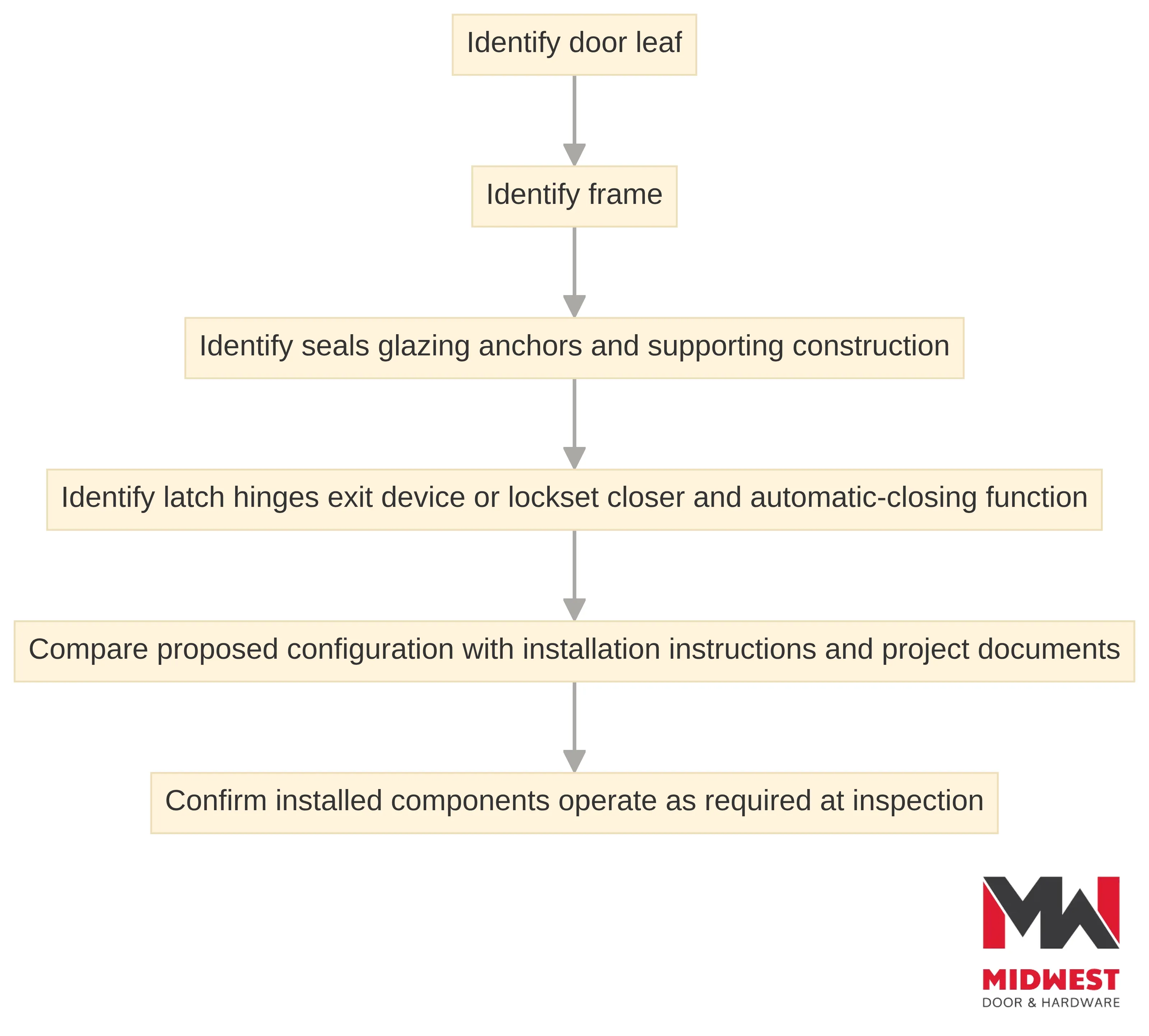
Trace the opening in a fixed order:
- Identify the door leaf and its listing information.
- Identify the frame and its listing or supporting documentation.
- Identify seals, glazing, anchors, and supporting construction that form part of the assembly.
- Identify the latch, hinges, exit device or lockset, closer, and any automatic-closing function.
- Compare the proposed configuration with the applicable installation instructions and project documents.
- Confirm that the installed components operate as required at inspection.
A listed door leaf and frame with positive latch and hinges do not establish a fire-protection-rated assembly if the required self-closing device is omitted. That example is useful because it shows why a door-only review can fail: the assembly depends on the function of the installed components, not merely on the label attached to one part.
Treat the assembly record as a chain. Every link must be identified, supported, installed correctly, and able to perform its required function before you release the opening.
The same logic applies when access control is added. An electrified lock, reader interface, request-to-exit device, or other security component must be coordinated with the listed latching and closing arrangement. The access function cannot be reviewed separately from the fire-door functions that remain necessary for the opening.
Compare the label with the project requirement
The project requirement belongs beside the label transcription, not behind it. Compare the marked opening and its supporting documents with the door schedule, frame details, hardware groups, specifications, wall construction, opening location, and any applicable authority or inspection requirements.
Your comparison record should answer these questions:
- Which opening number and location correspond to the physical door and frame?
- What fire-protection rating is scheduled for the opening?
- What wall or barrier contains the opening?
- Which hardware group is assigned to the opening?
- Does the hardware group identify a closer, automatic-closing device, positive-latching lockset, exit device, seals, or other rated-opening components?
- Do the label and listing documents support the scheduled configuration?
- Are there substitutions, field modifications, or unresolved discrepancies?
That rating belongs to the opening protection being evaluated, not automatically to every surrounding construction element. The required fire-protection rating for an opening can differ from the fire-resistance rating of the surrounding barrier; for example, a 2-hour fire barrier enclosing an exit stair may use 1½-hour fire-protection-rated door assemblies.
Keep those two ratings distinct in your schedule review. Do not copy the barrier rating into the door record, and do not use a door label to decide the required rating for the surrounding wall. If the schedule, specifications, label, and listing record point to different requirements, hold the opening for formal resolution before ordering or installing hardware.
Also compare the physical opening with the scheduled opening number rather than assuming that adjacent openings share the same requirement. Record the wall condition and opening location alongside the rating because the same hardware group can appear in different project contexts. A discrepancy in the schedule is a coordination issue to resolve, not a reason to select the nearest matching product.
Confirm the rating instead of inferring it
The rating on a commercial fire door must come from the applicable label and documentation, not from the door’s appearance, age, material, or frame shape.
An unmarked frame requires particular care. If a frame lacks an hourly rating, the rating is typically understood to be up to 1½ hours maximum in drywall installations or up to 3 hours in masonry installations, but the specific rating should be confirmed with the manufacturer. Treat that convention as a prompt for confirmation, not as permission to fill in the project record.
Use this rating gate before release:
- Transcribe the rating exactly as marked.
- Identify whether the rating belongs to the door, frame, or complete assembly record.
- Compare the rating with the scheduled opening requirement.
- Confirm the wall construction and installation condition.
- Obtain manufacturer or listing documentation for any unclear or unmarked component.
- Escalate conflicts rather than selecting the higher-looking or more familiar value.
A rating that is inferred rather than documented can lead to the wrong hardware package and an unresolved inspection issue. Keep the rating question open until the project documents and responsible reviewers establish the applicable answer.
Do not use the highest rating visible anywhere in the opening as a default. The surrounding barrier, door leaf, frame, and complete opening may have different rating references, and the project requirement determines which comparison applies.
Run the hardware compatibility gate
The proposed hardware package must pass a compatibility gate before it is ordered for a rated opening. Review the lockset, exit device, hinges, closer, automatic-closing device, latching function, seals, and any electrified interface against the applicable listing, installation instructions, schedule, and opening conditions.
For a fire-rated opening, coordinate the specified fire exit hardware, self-closing or automatic-closing device, and positive-latching lockset rather than assuming ordinary panic or lock hardware is acceptable. The hardware group is part of the opening decision. A component that fits the preparation or performs a similar access function may still require separate documentation for the rated assembly.
Use a component-by-component check:
- Locking and latching: Identify the listed lockset or exit device, the required positive-latching function, and the relationship to the frame preparation.
- Closing: Confirm the specified closer or automatic-closing device and the conditions under which it must operate.
- Hinges and pivots: Match the proposed hardware to the door construction, weight, preparation, and assembly documents.
- Exit hardware: Distinguish fire exit hardware from ordinary panic hardware when the opening schedule requires the former.
- Seals and protection: Identify the seals or other assembly components shown in the listing or installation documents.
- Electrified interfaces: Document how any electrified hardware is coordinated with the listed door, frame, latching, and closing arrangement.
UL identifies GSNN as a category for fire door assemblies and window assemblies evaluated under UL 10B, UL 10C, or UL 9. Use the applicable product category and certification directory information for the product or assembly being verified; do not treat a category reference as approval for an unrelated configuration.
If the proposed hardware cannot be traced to the opening’s listing or project documentation, stop the order and obtain a documented answer. Compatibility is a verification result, not an assumption based on brand familiarity or dimensions.
A hardware package can also fail coordination when the individual parts are acceptable but the operating functions conflict. Check that access control, positive latching, closing, and egress requirements are addressed together before treating the package as complete.
Control substitutions as formal decisions
A hardware substitution is a formal project decision, not a product swap based on appearance, dimensions, availability, or a claim that two items perform the same general function. A certification mark must be read in its application context, and each product category has its own intended use, limitations, and evaluation standard.
Before accepting a substitution, assemble the decision record:
- The originally specified component and the proposed replacement.
- The opening number, door and frame identifiers, and required rating.
- Listing or certification information for the proposed component and configuration.
- Installation instructions and preparation requirements.
- Effects on latching, closing, egress, seals, access control, and other assembly functions.
- Written project approval from the responsible design or reviewing party.
- Any manufacturer, listing-agency, or authority review required for the change.
Use the applicable product category and certification directory information to verify a listed or classified door, assembly, or related hardware product. Do not use a general certification record to cover a different product, opening, or installation condition. A record for a lockset does not by itself settle the status of the complete fire-door assembly.
Field modifications also require documentation. Supporting information for both the fire-door frame and door allows an inspector or authorized evaluator to identify the modification and address the opening correctly. If the substitution changes the configuration beyond the documented listing, keep the opening on hold until the responsible parties determine the permitted path.
A dimensional match is only one part of the decision. The replacement must also be evaluated for the opening’s rating, preparation, latching, closing, seals, access-control interface, and installation conditions. Record the answer for the specific opening instead of relying on a product-level similarity statement.
Resolve missing, altered, or modified labels
A missing, altered, painted-over, or inconsistent label creates a documentation problem for a specific opening. Preserve the condition you found, gather the door and frame records, and use an authorized labeling or evaluation path rather than assigning a replacement rating from memory or appearance.
Field labeling may be necessary after field modifications, when doors left the factory without labels, or when labeling is incorrect, painted over, or removed. The inspector conducting that work must have supporting documentation for both the fire-door frames and doors so field modifications can be identified and the opening protective can be properly relabeled.
A field evaluation examines the specific non-labeled or modified labeled assembly, its construction, and component operation, including hardware functionality and door condition. When the specific assembly complies with construction and installation requirements, UL Solutions applies a UL Evaluated Label to the product. That pathway concerns the specific assembly evaluated; it does not convert every similar door or hardware combination into an approved configuration.
Use the following response sequence:
- Photograph the label condition and record the opening location.
- Preserve the existing label and do not paint, remove, or alter it while the issue is under review.
- Collect the door, frame, hardware, schedule, specification, and modification records.
- Identify the manufacturer, listing agency, or authorized evaluator responsible for the next determination.
- Provide the supporting documentation for both the door and frame.
- Record the resulting label, evaluation, limitation, or required corrective work.
Do not order replacement hardware simply because the existing label is difficult to read. First determine what the opening is, what changed, and which documentation can support the specific condition.
If the label has been altered during painting, repair, or hardware work, photograph the surrounding condition as well as the marking. The change may affect how the opening is reviewed, and the door and frame records may be needed to identify the original configuration. Keep the resolution tied to that opening rather than applying it to similar doors elsewhere in the building.
Build a pre-release verification record
A pre-release verification record gives each opening one place for its label, listing, hardware, project requirement, and unresolved decisions. Use the record before procurement, substitution approval, installation, and closeout. Its purpose is to show what was compared and which questions remain open.
Include these fields for every affected opening:
- Project identity: project name, building, floor, opening number, and location.
- Physical opening: door leaf, frame, wall condition, swing, glazing, seals, and visible modifications.
- Label capture: exact transcription, photographs, label location, condition, and date recorded.
- Certification reference: agency, listing or certification identifier, applicable category, evaluation standard, intended use, and limitations.
- Rating requirement: scheduled opening rating, surrounding barrier rating where relevant, and the document that establishes each value.
- Hardware package: hinges, lockset, exit device, closer, automatic-closing device, latching function, seals, and electrified interfaces.
- Installation conditions: preparation, clearances, wall construction, anchors, supporting structure, and instructions that affect the assembly.
- Changes and exceptions: substitutions, field modifications, missing information, damaged labels, and unresolved conflicts.
- Review path: supplier, manufacturer, listing agency, architect, authority, or other responsible party assigned to each question.
- Release status: approved, held, corrective work required, or awaiting documentation, with the responsible reviewer and date.
A fire-door assembly is evaluated as a complete assembly; if a component is not properly provided, installed, and functioning, the assembly is not considered fire-protection-rated. Your record should therefore connect the door and frame to the seals, hardware, and supporting structure instead of storing those details in separate unlinked notes.
Use the record as a release gate. If the rating, listing scope, hardware compatibility, installation condition, or approval status is blank, keep that opening out of the released hardware order until the responsible party resolves the blank.
Give each opening its own record even when several openings share a schedule or hardware group. A shared specification can provide the starting requirement, but it does not replace the physical label, field condition, and listing review for each opening. Add a revision date whenever the hardware package, label information, or project requirement changes.
Ask the right party each unresolved question
Unresolved label and hardware questions move faster when you direct each question to the party that controls the relevant document or decision. Bring the opening number, label transcription, photographs, door and frame identifiers, schedules, proposed hardware, and modification history to every conversation.
Ask the supplier:
- What door, frame, and hardware information is needed to interpret this opening?
- Which proposed components are being matched to the scheduled opening?
- What documents identify the rating, listing scope, installation conditions, and limitations?
- Which items remain unresolved before the hardware can be released?
Ask the door or hardware manufacturer:
- Does the proposed component appear in the applicable listing or certification information for this configuration?
- What preparation, latching, closing, seal, or installation conditions apply?
- Does the proposed substitution change the listed arrangement?
- What documentation supports the door, frame, and complete assembly together?
Ask the listing agency or authorized evaluator:
- What certification category and evaluation standard apply to this product or assembly?
- How should the physical marking be interpreted when a field condition differs from the record?
- What documentation is required for a missing, damaged, painted-over, or modified label?
- Does the proposed field evaluation or labeling path address this specific opening?
Ask the architect or responsible design professional:
- What opening rating and hardware group apply to this opening number?
- How should conflicts between the schedule, specifications, label, and field condition be resolved?
- Is the proposed substitution acceptable within the project’s design and approval process?
Ask the authority having jurisdiction:
- What project-specific documentation or inspection review is required for the unresolved condition?
- Which approval must be recorded before installation or occupancy?
- Does the proposed labeling, evaluation, or corrective path address the authority’s requirements?
A certification mark must be read in its application context, and supporting documentation for both the door and frame is needed when field labeling or modification review is involved. Route each question with that documentation attached, then record the answer in the opening verification record.
Ask for a written response when the answer changes the rating, listing scope, hardware package, installation method, or release status. A verbal explanation can help identify the issue, but the opening record should show the document or approval that resolves it.
Apply the process to a Lincoln project without making the code decision
A Lincoln, Nebraska commercial opening should use the same document-first process as any other project: capture the mark, identify the complete assembly, compare the opening with the schedules, and hold unresolved rating or hardware questions for the responsible reviewers. The workflow helps you organize the decision; it does not assign the project-specific code, listing, or inspection result.
For a project in Lincoln’s Haymarket District, or for work in Omaha, Scottsbluff, North Platte, Council Bluffs, Grand Island, David City, Columbus, or Aurora, keep the opening record tied to the actual building, wall condition, opening location, and adopted project requirements. If the project also has tornado-related, shelter, or other special design requirements, keep those requirements on their own approval path rather than assuming that a fire-door marking answers them.
Use the local project team to resolve questions about the applicable design documents, inspection expectations, and authority review. Certification marks are important in code and inspection review, and NFPA 80 governs fire-door installation where testing is most often conducted under ANSI/UL 10C for hinged, swinging doors. Most building codes and standards require fire doors to be inspected not less than annually by a qualified person familiar with the assembly’s operating components. Those references help frame the review, but they do not replace the project’s responsible design, listing, or inspection decision.
Your Lincoln coordination packet should contain the opening schedule, label photographs, door and frame information, hardware group, proposed substitutions, listing documents, and a short list of unresolved questions. Send the same packet to each reviewer so the supplier, manufacturer, design team, and authority are responding to one consistent opening record.
For small and midsize contractors, security integrators, schools, hospitals, offices, churches, arenas, and community facilities, the practical value is the same: keep the opening-specific record intact as information moves from design to procurement and installation. A Lincoln location does not change the need to verify the exact assembly.
Close the loop through inspection and maintenance
A fire-door verification record remains useful after procurement because the complete assembly must continue to be properly installed and functioning. The label and approved hardware package do not remove the need to inspect the installed opening and document maintenance conditions.
Use the inspection record to connect the observed condition with the original opening record, including the door, frame, latching, closing, seals, hardware, and any approved field changes.
A practical maintenance file should retain:
- The original label transcription and photographs.
- Door, frame, hardware, listing, and installation documents.
- Approved substitutions and field evaluations.
- Inspection dates, findings, corrective actions, and responsible parties.
- Records showing when repaired or modified components were returned to service.
When a closer no longer operates, a latch does not engage, a seal is damaged, or a field change alters the assembly, treat the issue as an assembly question rather than an isolated hardware replacement. Compare the condition with the listing and project record, then route the corrective decision to the appropriate qualified party. Keep the verification record updated so future inspection and maintenance work starts with the actual opening history.
Annual inspection is not a substitute for documenting repairs or changes. Update the opening record when a component is replaced, when the label condition changes, or when the installation differs from the prior record. The next inspection should be able to connect the observed hardware and assembly condition to the documents used for the original release.
Request coordinated follow-up before release
A complete opening record gives your project team a clear basis for resolving the label, rating, listing, hardware, and installation questions before release. We provide commercial door hardware including hinges, locks, exit devices, door closers, and electrified hardware. We also provide installation assistance and services tailored for commercial projects.
Bring the label transcription, door and frame information, opening schedule, proposed hardware package, listing documents, substitutions, and unresolved questions into the coordination process. The responsible design professionals, manufacturers, listing agency, and authority having jurisdiction must make project-specific suitability and approval decisions.
What should be confirmed before hardware is ordered?
How can I verify the compatibility of hardware with a Warnock Hersey-labeled fire door?
To verify hardware compatibility, check the specific listing or certification documentation for the fire door, and ensure that the proposed hardware meets the requirements for fire-rated openings, including the necessary functions like self-closing and positive latching.
What should I do if a fire door label is damaged or missing?
If a fire door label is damaged or missing, document the condition and gather supporting records for the door and frame. A field evaluation may be necessary to determine compliance, and the door should not be replaced or modified until the issue is resolved through proper channels.
What are the key components of a fire door assembly that must be verified?
Key components of a fire door assembly that must be verified include the door leaf, frame, seals, hardware, and the installation conditions. Each component must be compatible and functioning correctly to ensure the assembly meets fire protection requirements.
How often should fire doors be inspected?
Most building codes require fire doors to be inspected at least annually by a qualified person familiar with the assembly’s operating components to ensure they are functioning properly and maintaining compliance.
What information should I compare when verifying a fire door's rating?
When verifying a fire door’s rating, compare the physical label with the project requirements, including the scheduled fire-protection rating, wall construction, and any applicable authority or inspection requirements.
What steps should I take before ordering hardware for a fire-rated opening?
Before ordering hardware for a fire-rated opening, ensure that you have verified the door and frame compatibility, confirmed the required hardware functions, and resolved any discrepancies in the project documentation.
Start Your Build
Got a project? We'll bring frames, doors, hardware, and the expertise to keep every opening on schedule.