
door distributors near me
How to Choose a Commercial Door Distributor Near You for a Nebraska Fire-Rated Project
Start with the fire-rated opening, not the search result
A Nebraska fire-rated project should be evaluated through the complete opening record, not through a search result or a distributor’s distance from the jobsite. A nearby supplier may still be a poor fit if the requested rating, hardware coordination, delivery expectations, installation arrangements, or service responsibilities are unclear. Start by identifying what each opening must do, then compare the support available for that specific scope.
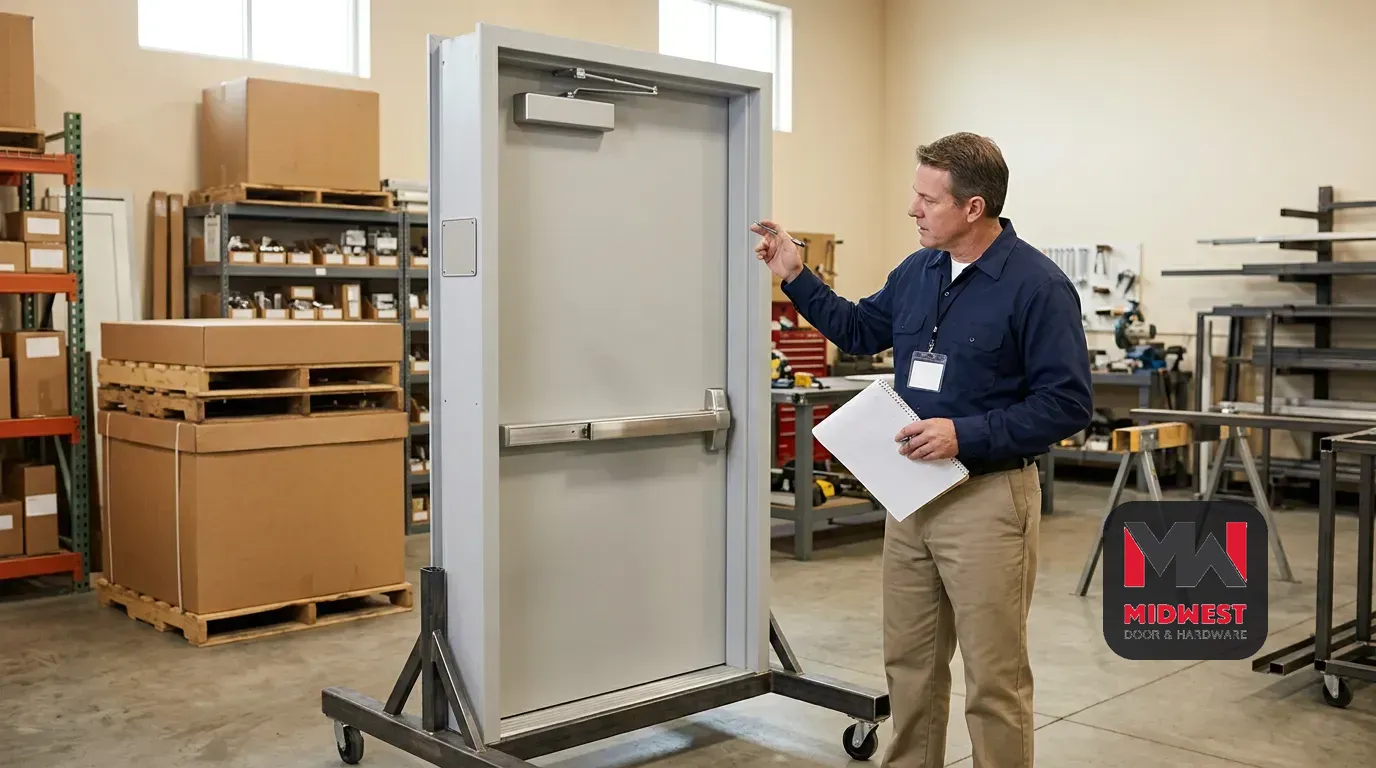
A fire rating indicates how long a complete door, frame, and hardware assembly has been tested to resist the passage of fire and smoke. The rating applies to the assembly rather than to the door leaf by itself. The door, frame, and hardware must carry matching fire labels for the assembly to be code-compliant, so a distributor comparison should begin with the opening as a coordinated system.
Fire-rated door assemblies are required where applicable building codes mandate fire- and smoke-compartmentalization, including stairwells, corridors, mechanical rooms, and occupancy separations. A school corridor, hospital stairwell, church assembly area, arena service opening, or public-building mechanical room may therefore require different documentation and hardware coordination. The applicable requirement belongs to the project’s design and code review, not to a generic online listing.
The practical answer is to organize the opening information before you compare distributors. A credible follow-up should address the exact location, opening conditions, labeled assembly, hardware set, delivery expectation, installation responsibility, and future service need. Treat proximity as one question in that review, not as proof of availability, compliance, or project fit.
Use the same opening record when you compare providers. For each opening or opening group, keep the required rating, door and frame information, hardware set, project location, requested delivery point, installation arrangement, and service question together. That format lets you compare responses on the same conditions instead of judging a general product description against a project-specific proposal.
Build the opening record from the schedules
A door schedule gives each opening a number tied to the floor plan and can list the door size and thickness, door design and material, frame type and material, fire rating, and hardware set number. That information gives you a common record for requesting pricing and discussing technical questions with a commercial door distributor. It also makes it easier to identify which openings share a hardware set and which require separate review.
A useful opening record should preserve the schedule information rather than reducing the project to a door count. Assemble the following for each opening or opening group:
- Opening number and its location on the floor plan.
- Door size and thickness.
- Door design and material.
- Frame type and material.
- Required or specified fire rating.
- Hardware set number.
- Separate hardware schedule information identifying what each set contains.
- Any open question about accessibility, field conditions, approvals, or responsibility for installation and adjustment.
A schedule review should connect each listed opening to the scope you want priced or discussed. If the project is in Lincoln, North Platte, Grand Island, Scottsbluff, Omaha, or another Nebraska community, place the complete project location beside the opening information. Identify whether you are asking about new assemblies, replacement openings, repair, hardware changes, or a combination. A distributor can respond more usefully when the request separates known requirements from unresolved questions.
An incomplete schedule should be treated as an open coordination item, not as permission to guess. If the door schedule, hardware schedule, floor plan, or rating information conflicts, mark the conflict in the inquiry and send it to the responsible design professional or authority for resolution. Do not select a fire-rated assembly from size or appearance alone.
Keep the project packet usable for both pricing and follow-up. Put the opening list or door schedule first, attach the related hardware schedule, and note which entries are confirmed, missing, or disputed. Add the jobsite city and facility name to the packet so a distributor can consider serviceability and delivery responsibilities alongside the opening details.
Check the rating and hardware as one assembly
Fire-rating levels describe tested resistance time for the complete assembly, but the applicable level depends on the opening condition and project requirements. A cited commercial door schedule guide lists 20-minute, 45-minute, 60-minute, 90-minute, and 180-minute ratings for different conditions. The minute value measures the tested duration under controlled conditions; it does not tell you which rating belongs at every opening.
The cited guide associates 20-minute ratings with corridor doors and smoke barriers in sprinklered buildings where a lower rating is permitted by code, 45-minute ratings with corridor doors in 1-hour rated corridors, 60-minute ratings with openings in 1-hour rated fire barriers and shaft enclosures, 90-minute ratings with openings in 2-hour rated fire barriers, stairwell enclosures, and exit passageways, and 180-minute ratings with openings in 3- and 4-hour rated fire walls. Use those descriptions as questions to reconcile with the project documents, not as an independent rating decision.
Fire-rated hardware must be used for fire-protection doors, including hinges, locks, and closers. The complete assembly still requires coordination: the door, frame, and hardware must carry matching fire labels. Ask the distributor to identify how the proposed hardware set corresponds with the listed door and frame assembly, and record any item that needs design or authority review.
Commercial-grade door selection should account for material, fire ratings, and accessibility. Those criteria affect the questions you ask about hollow metal doors, wood doors, frames, hinges, locks, closers, and other hardware. Accessibility questions should remain tied to the project documents and applicable requirements; do not treat a distributor’s product description as an individualized accessibility determination.
A commercial-door source for the Omaha region reports that corridor doors commonly require 20-minute or 45-minute fire ratings, while stairwell and shaft enclosures may require 60-minute to 90-minute rated assemblies. The source describes Omaha-region conditions, so use the information as a planning prompt for a Nebraska project rather than transferring it automatically to a Lincoln opening. Confirm the rating for each opening through the project requirements.
Use these questions when reviewing a proposed opening package:
- What project condition establishes the required fire rating?
- Do the door, frame, hinges, locks, closers, and other listed hardware correspond to the complete assembly?
- Are the material and accessibility requirements identified in the project documents?
- Which items are confirmed, and which still require design-professional or authority review?
Record the answer against the opening number rather than treating a product name or label as a complete compliance decision.

Compare local project fit before relying on proximity
A distributor’s fit can vary by project because location, delivery expectations, installation arrangements, and service responsibilities may differ. The phrase “door distributors near me” identifies a search starting point, not a verified service relationship. A supplier close to a Lincoln jobsite may not have the needed product, delivery arrangement, installation role, or repair responsibility for your opening package.
A local-fit check should answer four practical questions:
- Is the project location within the distributor’s stated Nebraska service context?
- What delivery expectations apply to the identified opening record and requested materials?
- Who handles installation, installation assistance, adjustment, and coordination with a third-party installer?
- Who handles repair or service after the opening is in use?
Put the project location in the inquiry and ask about serviceability before relying on product availability, delivery expectations, installation assistance, or repair support.
The words “near me” do not establish local product availability. Do not infer that a distributor covers a project in Lincoln, Omaha, North Platte, or another Nebraska location simply because an online search displays the business nearby. Ask about the specific project location and responsibilities, then keep the answer with your project record.
Make the comparison concrete by recording the response for each provider under the same headings: project location, delivery expectation, installation role, installer coordination, repair responsibility, and service responsibility. A provider that answers only the product question has not answered the full project-fit question. Keep unresolved responsibilities visible before you schedule work or rely on a quoted scope.
Separate product supply from project support
Product supply and project support are separate parts of a commercial door decision. A distributor may provide a door or hardware while leaving installation, third-party coordination, adjustment, repair, and continuing maintenance to different parties. Your inquiry should name each responsibility so that a product quote is not mistaken for a complete project-support commitment.
A distributor is better prepared for project-specific follow-up when the location is identified, the scope is clear, the opening record is organized, and unresolved approvals are visible. Use that standard to separate the support you need:
- Pricing: Can the distributor receive the door schedule or opening list and identify the assumptions behind the price?
- Hardware: Can the distributor provide the commercial door hardware associated with the opening record and identify coordination questions?
- Installation: Is installation offered, assisted, or left to your installer?
- Installer coordination: If another contractor installs the assembly, who coordinates the handoff and what information must be exchanged?
- Adjustment and repair: Who handles field adjustments, commercial door repair, and service after installation?
- Maintenance: What maintenance responsibility will remain with the facility team or service provider?
Mark each answer as assigned, unresolved, or outside the requested scope.
At Midwest Door & Hardware, we can receive a door schedule or opening list for pricing, provide commercial door hardware, and provide commercial door repair and service. At Midwest Door & Hardware, we can address installation assistance and third-party installer coordination as separate responsibilities. Those statements describe the responsibilities we can discuss for an inquiry; they do not assign every installation, inspection, or approval duty to Midwest Door & Hardware.
Maintenance protocols support the long-term performance of commercial-grade doors. Include maintenance in the comparison when the project involves a school, hospital, church, arena, office, or community building with many openings and recurring facility responsibilities. Ask how maintenance, adjustments, and service records will be handled without treating a general maintenance discussion as proof that an existing assembly complies.
Ask for a response that distinguishes what is included from what remains with another project participant. Keep pricing, hardware, installation assistance, third-party coordination, repair, and service as separate lines in your notes. This makes it easier to identify a gap before construction or replacement work begins.
Use generic lead times only as an early planning question
Commercial door lead times should be treated as an early planning question until the distributor reviews the actual opening record. A January 29, 2026 guide reported that stock doors usually ship within a week, while custom doors typically take 4-16 weeks from order to delivery depending on complexity, materials, and manufacturer schedules. Those figures describe generic stock and custom door timing, not a guaranteed timeline for a complete Lincoln fire-rated assembly project.
Many stock doors are slabs in inventory that can be assembled with jambs, trim, and handing within a few days. Custom doors typically take 4-16 weeks from order to delivery in the cited guide. The 4-16-week range measures the period from order to delivery for custom doors, while the within-one-week figure describes usual shipping for stock doors; neither figure includes every design review, hardware decision, field condition, installation step, inspection, or approval.
Ask the distributor to separate the timing of each project stage:
- Review of the door schedule or opening list.
- Confirmation of the proposed material, rating, frame, and hardware.
- Manufacturer production or assembly.
- Delivery to the Nebraska project location.
- Installation, adjustment, inspection, and turnover.
Order early and confirm lead times before scheduling the project. Keep the confirmed timing tied to the identified scope rather than using a generic estimate as the construction schedule.
A stock-door estimate should not be applied to a custom frame, labeled assembly, special hardware set, or incomplete opening record. Ask what could change the timing and which milestones depend on unresolved approvals. That question gives you a more useful planning answer than asking how long a distributor “usually” takes.
Use the generic figures to decide when to start the conversation, not to set the installation date. A custom-door range of 4-16 weeks measures order-to-delivery time for custom doors; it does not measure the complete project duration. Put the required milestone in your inquiry and request timing for the actual material, assembly, hardware, and jobsite conditions.
Assess Midwest Door & Hardware as a starting point for the inquiry
At Midwest Door & Hardware, we stock fire-rated assemblies, hollow metal doors, wood doors, hardware, and Division 10 items, and we offer frames, doors, hardware, and expertise for building projects. That stated offering makes Midwest Door & Hardware a commercial starting point for an opening-level inquiry from a Nebraska school, hospital, public building, church, arena, office, or community facility.
At Midwest Door & Hardware, our product offering can provide a commercial starting point for opening-level review, but it does not establish that a particular opening complies with its project requirements. The project record still needs to identify the applicable rating, labeled door and frame, compatible hardware, accessibility considerations, installation arrangement, and unresolved approvals. Use the inquiry to connect those project questions with the opening list or schedules.
Use Midwest Door & Hardware’s stated offering as a starting point by sending the project location, the opening record, the requested product scope, and the support questions. Separate what you need priced from what you need coordinated or serviced. A useful response should be specific to the opening record rather than a general statement about fire-rated doors.
Prepare a follow-up that can be answered
A project-specific inquiry should give the distributor enough organized information to identify the requested work and enough context to separate known requirements from unresolved approvals. Identify the building and location first, then describe the openings and the response you need.
Include these items in your follow-up:
- Project location: Give the city, facility, and jobsite location in Nebraska.
- Project stage: Identify whether you are planning, pricing, replacing, repairing, or coordinating installation.
- Opening record: Attach the door schedule, hardware schedule, opening list, or available floor-plan references.
- Assembly details: Identify opening numbers, sizes, materials, frame information, fire ratings, and hardware set numbers.
- Known questions: Mark missing information, conflicting schedule entries, accessibility questions, field conditions, or approvals that remain unresolved.
- Requested response: State whether you need pricing, product coordination, delivery information, installation assistance, third-party installer coordination, repair, adjustment, or service discussion.
- Timing: Give the target project milestone and ask for project-specific lead-time information before scheduling work.
A clear inquiry should ask for responsibilities rather than assume them. Ask which parts of the request Midwest Door & Hardware can address, which parts require a third-party installer or another project participant, and which questions require design or authority review. Keep each answer beside the relevant opening or opening group.
A prepared follow-up gives you a basis for comparing the proposed product scope, delivery expectations, installation arrangement, service role, and unresolved approvals. It also keeps the inquiry from turning into a general product request that cannot address the fire-rated opening conditions.

Get qualified help when the opening raises a life-safety concern
A suspected fire-rated opening problem should be handled as a life-safety and compliance concern, not as a routine product substitution. If an opening appears improperly installed, fails to close, has damaged components, or conflicts with the project record, stop treating a nearby product source as the answer and obtain qualified evaluation. Hire a professional in Lincoln, Nebraska, for fire-door installation to help ensure proper installation and compliance with local codes; incorrect installation can compromise the door’s effectiveness in an emergency.
Perimeter gaps deserve prompt attention from qualified personnel. A cited NFPA Journal passage reported that gaps around fire-door perimeters were probably one of the top two deficiencies inspectors found and could involve dozens of doors in a single building. Do not enlarge, pack, shim, trim, or otherwise alter a rated opening based only on an informal observation; document the opening and route the concern to the responsible professional or inspection and service provider.
Rolling fire doors must be inspected, tested, and maintained in accordance with NFPA 80, including an annual inspection. The annual frequency applies to rolling fire doors. Keep a documented maintenance record for the inspection and any corrective work, and distinguish rolling-door procedures from the requirements for other fire-rated opening types.
The described rolling-door inspection uses two drop tests. The first checks proper operation and full closure; the second checks that the complete assembly, including the automatic closing device, was reset correctly according to the manufacturer’s instructions. That two-test procedure belongs to the described rolling-door inspection and should be carried out by qualified personnel using the applicable instructions.
Fusible links, release devices, and other movable parts should be checked for paint or coatings that could interfere with operation. Do not paint over, disable, remove, or adjust those components as a do-it-yourself repair. Record what you observed and obtain the appropriate inspection or service response.
Openings in high-separation walls may require ratings up to 3 hours with welded frame construction. A three-hour rating is one possible rating level for the described high-separation conditions; it does not establish that every Nebraska high-separation opening needs that rating. Take the wall, occupancy, opening, and frame requirements to the responsible design professional or authority before selecting or modifying an assembly.
Do not infer compliance from a matching-looking door, a nearby distributor, a product label viewed without the frame and hardware, or a generic installation estimate. Do not schedule replacement or make field changes until the opening requirements and responsibilities are clear. Seek immediate qualified help when a fire-rated opening will not close, shows a substantial gap or damaged release component, or may be unable to perform its required life-safety function.
Route concerns according to the condition you observe. Use a qualified professional for installation or suspected installation problems, use the applicable inspection and service provider for rolling-door testing and maintenance, and send unresolved code, life-safety, or accessibility questions to the responsible design professional or authority. A distributor can discuss products and project support, but that discussion does not replace the responsible project review.
Request a project-specific review of your opening record
A suitable Nebraska distributor inquiry starts with the project location, a clear scope, an organized opening record, and visible unresolved approvals. Send the door or hardware schedules or opening list, identify the fire-rated assembly questions, separate supply from installation and service responsibilities, and ask for timing tied to the actual project. A qualified design professional, authority having jurisdiction, or other responsible authority must decide project-specific code, life-safety, accessibility, and individual suitability questions; distributor follow-up does not replace that determination.
At Midwest Door & Hardware, we can review an inquiry built around your Nebraska project location, requested scope, opening records, and questions, with our stated frames, doors, hardware, and fire-rated assembly offering as the starting point for the discussion.
What should I ask a distributor about project responsibilities?
What should I send a distributor before requesting pricing?
Provide the Nebraska facility and jobsite location, project stage, door schedule or opening list, hardware schedule, floor-plan references, and any available information about opening numbers, sizes, materials, frames, fire ratings, and hardware sets. Mark missing or conflicting information separately so the distributor does not have to infer requirements.
How can I verify that installation and service responsibilities are covered?
Ask separately who handles product supply, installation, installer coordination, field adjustment, repair, maintenance, and service after installation. A distributor may provide doors and hardware without taking responsibility for every installation or approval duty. Keep each responsibility assigned, unresolved, or outside the requested scope.
What should I do if an existing fire-rated opening appears unsafe or noncompliant?
Treat the condition as a life-safety concern and obtain qualified evaluation rather than making an informal substitution or field alteration. Seek professional help if the opening will not close, has substantial perimeter gaps, shows damaged release components, or may not perform its required function. Code, accessibility, and project-specific compliance questions should go to the responsible design professional, authority, or qualified inspection and service provider.
Start Your Build
Got a project? We'll bring frames, doors, hardware, and the expertise to keep every opening on schedule.